Septoplasty vs Balloon Septoplasty: Which Nasal Septum Surgery Is Right for You?
If chronic nasal blockage is affecting your sleep, workouts, or day-to-day comfort, you may be comparing septoplasty vs balloon septoplasty. Both aim to improve airflow when a deviated septum is a major cause of obstruction—but they are not the same procedure, and they are not right for the same anatomy.
A helpful way to think about it: if the septum is the internal “divider wall” of your nose, traditional septoplasty is a structural renovation, while a balloon-assisted approach can be more like a targeted remodeling of select areas. Which one makes sense depends on where the bend is, how severe it is, and whether other structures contribute to blockage.
Below is a patient-friendly breakdown of how each option works, what recovery can look like, and a practical framework to help you discuss the best fit with an ENT.
Quick Answer: How Septoplasty and Balloon-Assisted Septal Remodeling Differ
Here’s the high-level comparison for skimmers:
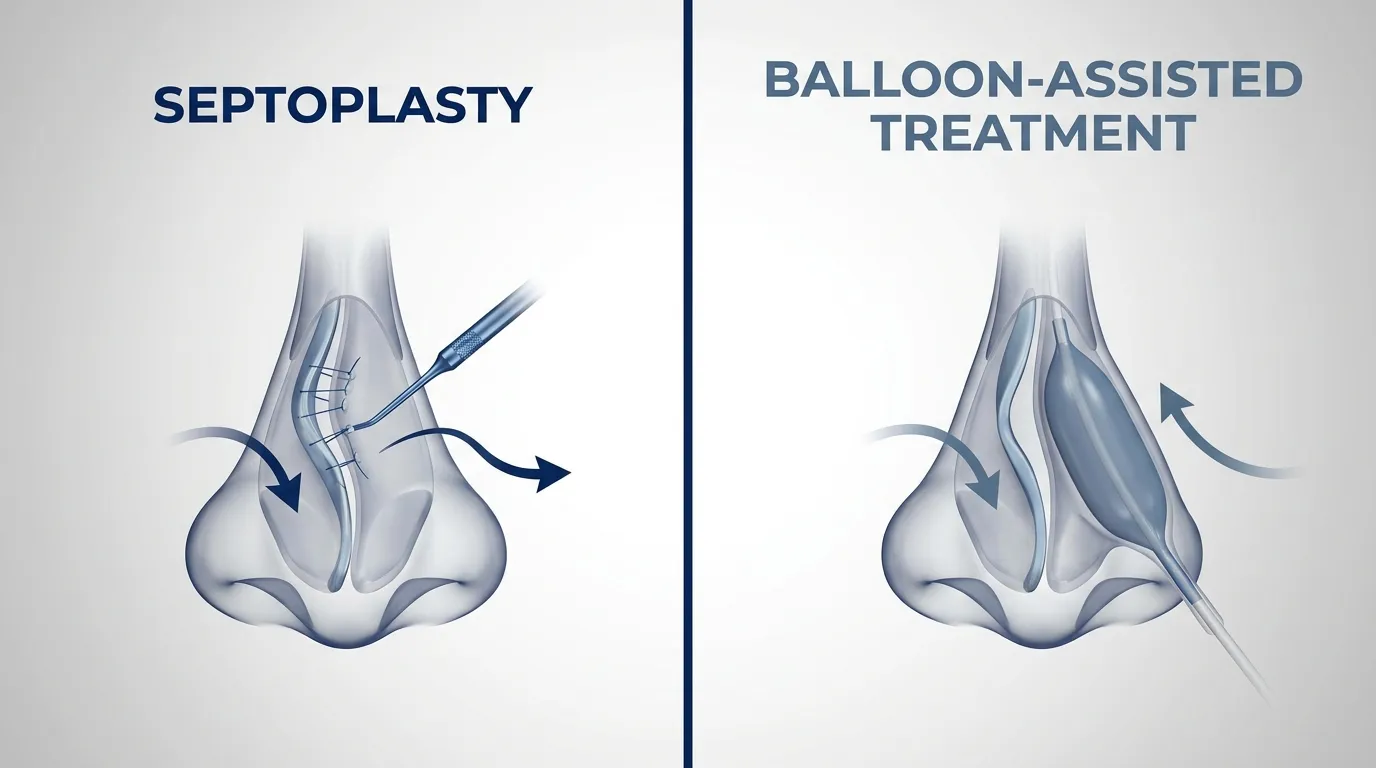
Traditional septoplasty
- Usually performed in a surgery center/operating room
- Corrects the septum by lifting the lining and reshaping, removing, or repositioning portions of cartilage and/or bone that contribute to obstruction
- Often considered for complex, severe, bony, or multi-area deviations
- May involve more downtime and a longer settling period
Balloon-assisted septal remodeling (sometimes called “balloon septoplasty” in some practices)
- In select cases, may be performed in the office depending on anatomy and clinician preference
- Uses controlled balloon inflation to remodel or reposition select septal areas in carefully chosen patients
- May be considered for select mild-to-moderate deviations in accessible locations
- May allow shorter recovery and faster return to routine, depending on the case and whether other procedures are performed
What both aim to do: improve nasal airflow and relieve obstruction related to septal deviation. (Cleveland Clinic; Mayo Clinic)
- Cleveland Clinic septoplasty overview: https://my.clevelandclinic.org/health/treatments/17779-septoplasty
- Mayo Clinic septoplasty basics: https://www.mayoclinic.org/tests-procedures/septoplasty/about/pac-20384670
In short, both aim to improve airflow, but they differ in scope, setting, and candidacy.

Understanding the Nasal Septum and a Deviated Septum (Patient-Friendly Basics)
What is the septum?
The nasal septum is the “wall” that divides your nose into left and right air passages. It’s made of cartilage in the front and bone in the back, all covered by a thin lining. If that wall bows into one side, airflow can feel like it’s moving through a hallway that suddenly narrows.
What does “deviated septum” mean?
A deviated septum means that wall is off-center or uneven—so one side (or sometimes both sides) can feel narrow. Many people have some deviation, but symptoms tend to show up when the deviation meaningfully blocks airflow.
Common symptoms that may point to septal deviation
- One-sided or alternating nasal blockage
- Mouth breathing (often worse at night)
- Snoring or poor sleep quality (not always from the septum alone)
- Frequent nosebleeds (sometimes)
- Facial pressure or a “congested” feeling that doesn’t match typical allergy/cold patterns
If you want a symptom-and-solution overview, see our page on deviated septum relief:
- https://sleepandsinuscenters.com/deviated-septum-relief
When symptoms may not be from the septum alone
A deviated septum can be part of the story—but it’s not always the only driver. Other common contributors include:
- Allergic rhinitis or chronic (non-allergic) rhinitis
- Turbinate enlargement
- Nasal valve collapse
- Sinusitis
This is why an ENT evaluation matters before choosing between septoplasty vs a balloon-assisted technique (or deciding whether you need septal correction at all).
A deviated septum is common; symptoms matter more than the label.

Causes and Risk Factors for a Deviated Septum
Common causes
- Natural growth and development (many people are not perfectly centered)
- Nasal trauma (sports injuries, falls, accidents)
- Prior nasal surgery or structural changes over time
Why severity and location matter for choosing treatment
Not all deviations behave the same:
- A mild front (cartilaginous) deviation may be managed differently than a deeper (bony) deviation.
- Spurs or complex bends that twist the septum in more than one plane often require a more comprehensive approach.
A concrete example: if the deviation is mainly a small, reachable bend, a balloon-assisted approach may be discussed. But if there’s a sharp spur or multiple bends involving bone, traditional septoplasty is more often the right tool.
Where and how the septum bends often determines the right tool.
Treatment Options Before Surgery (and When They’re Not Enough)
Non-surgical symptom relief (may help but won’t straighten the septum)
Medication and supportive care may reduce swelling and irritation around the septum, even if they can’t change the underlying structure:
- Saline rinses/sprays
- Allergy treatment when appropriate (for example, antihistamines or nasal steroid sprays)
- Managing irritants/dryness (humidification, avoiding smoke)
These steps are especially useful when symptoms are coming from both structure (septum) and inflammation (rhinitis). Less swelling can sometimes make a mild deviation feel less noticeable.
When conservative care is unlikely to fix the problem
Septal procedures are typically considered when symptoms persist and the septum is confirmed as a key cause of obstruction. (Mayo Clinic; Cleveland Clinic)
- https://www.mayoclinic.org/tests-procedures/septoplasty/about/pac-20384670
- https://my.clevelandclinic.org/health/treatments/17779-septoplasty
When structure is the driver, medication can help symptoms but not straighten the wall.
What Is Traditional Septoplasty?
How septoplasty works (simple step-by-step)
While details vary by surgeon and anatomy, traditional septoplasty generally involves:
1) Accessing the septum through the inside of the nose
2) Lifting the septal lining
3) Reshaping, removing, and/or repositioning portions of cartilage and/or bone that are blocking airflow
4) Returning the lining to support healing
The goal is improved airflow while preserving support.
Anesthesia and setting
Traditional septoplasty is commonly performed in an operating room or surgery center. Anesthesia varies (often general anesthesia; sometimes local with sedation depending on circumstances).
How long do results take to settle?
Many people notice improvement earlier, but healing is a process. Recovery and healing continue over time, with results generally becoming more stable over the following months. (Cleveland Clinic)
- https://my.clevelandclinic.org/health/treatments/17779-septoplasty
Think of septoplasty as a structural correction tailored to your anatomy.

What Is Balloon-Assisted Septal Remodeling?
What we mean by “balloon septoplasty”
Septoplasty is the well-established surgery to straighten the septum. In some practices, a balloon-assisted technique may be used to gently remodel select septal areas in carefully chosen patients. If you’ve heard the term “balloon septoplasty,” it typically refers to this balloon-assisted septal remodeling. It is distinct from balloon sinuplasty, which targets sinus drainage pathways rather than the septum.
How the procedure works
- A small balloon device is positioned at a targeted area
- The balloon is gently inflated to remodel or reposition the septal area
- Tissue disruption may be less than with traditional septoplasty in appropriately selected cases
In our practice, this may be offered via the ClearPath system; see our explainer for details:
- https://sleepandsinuscenters.com/blog/balloon-septoplasty-with-clearpath-a-less-invasive-fix-for-a-deviated-septum
Typical recovery experience
Many patients focus on downtime. Balloon-assisted approaches are often associated with shorter recovery in selected cases, especially when performed alone. Your experience will vary based on your anatomy and whether other procedures (for example, turbinate reduction) are performed at the same time.
Balloon-assisted remodeling is a selective tool, not a replacement for every septoplasty.

Septoplasty vs Balloon-Assisted Septal Remodeling (Side-by-Side Comparison)
Procedure setting
- Septoplasty: typically surgery center/OR
- Balloon-assisted remodeling: may be office-based in select cases, depending on anatomy and clinician preference
Invasiveness
- Septoplasty: surgical correction; may involve reshaping, removing, or repositioning cartilage and/or bone
- Balloon-assisted remodeling: targeted remodeling via controlled inflation; can involve less tissue disruption in selected cases
Recovery time and downtime
- Septoplasty recovery time: many plan for about a week of downtime, though congestion/swelling can last longer (Cleveland Clinic)
- Balloon-assisted remodeling: may allow shorter downtime, with many returning to routine sooner in selected cases
Source for septoplasty recovery expectations:
- https://my.clevelandclinic.org/health/treatments/17779-septoplasty
Success and outcomes (what to know)
Outcomes depend heavily on diagnosis, anatomy, and whether other causes of obstruction (like turbinate enlargement or nasal valve collapse) are addressed.
- One peer-reviewed study of septoplasty reported improvement on a validated nasal obstruction measure at 12 months; results vary by study design, patient selection, and outcome metric. (PMC)
- https://pmc.ncbi.nlm.nih.gov/articles/PMC6616214/
- For balloon-assisted septal remodeling, some provider materials describe high success in carefully selected patients, but definitions of “success” and patient populations vary. These figures should be considered context rather than guarantees.
Durability (how long results last)
- Septoplasty: generally considered a long-term structural correction, though healing/scar changes and other nasal conditions can affect symptoms
- Balloon-assisted remodeling: can provide lasting benefit in the right anatomy, but complex deviations may require additional or alternative treatment
Best candidates (at a glance)
- Balloon-assisted: may be considered for select mild-to-moderate deviation in accessible locations, especially when minimal downtime is a priority
- Traditional: often preferred for severe deviation, bony deviation, spurs, complex multi-area obstruction, or revision needs
The right approach depends on anatomy, goals, and clinician judgment.

Symptoms That May Improve After Septal Correction
Breathing and sleep-related symptoms
Many patients report:
- Less nasal blockage at rest and with activity
- Less mouth breathing at night
- Better sleep comfort (noting that sleep issues can have multiple causes)
Recurrent congestion that doesn’t respond to meds
If obstruction is primarily structural, medication alone may not fully resolve the blockage.
When symptoms may persist even after successful septal work
Even well-performed septal correction may not eliminate symptoms caused by:
- Allergies/chronic rhinitis
- Turbinate hypertrophy
- Nasal valve collapse
Breathing gains are most reliable when the main bottleneck is the septum.
Risks, Side Effects, and Limitations (Honest and Reassuring)
Traditional septoplasty risks (overview)
Potential risks/complications can include:
- Bleeding, infection
- Ongoing congestion during healing
- Septal perforation (rare)
- Persistent obstruction or need for revision in a subset of patients
Source:
- https://my.clevelandclinic.org/health/treatments/17779-septoplasty
Balloon-assisted septal remodeling limitations/risks (overview)
- Not appropriate for all deviation types
- May not fully correct complex or bony deviations
- Some patients may still need traditional septoplasty if results are incomplete
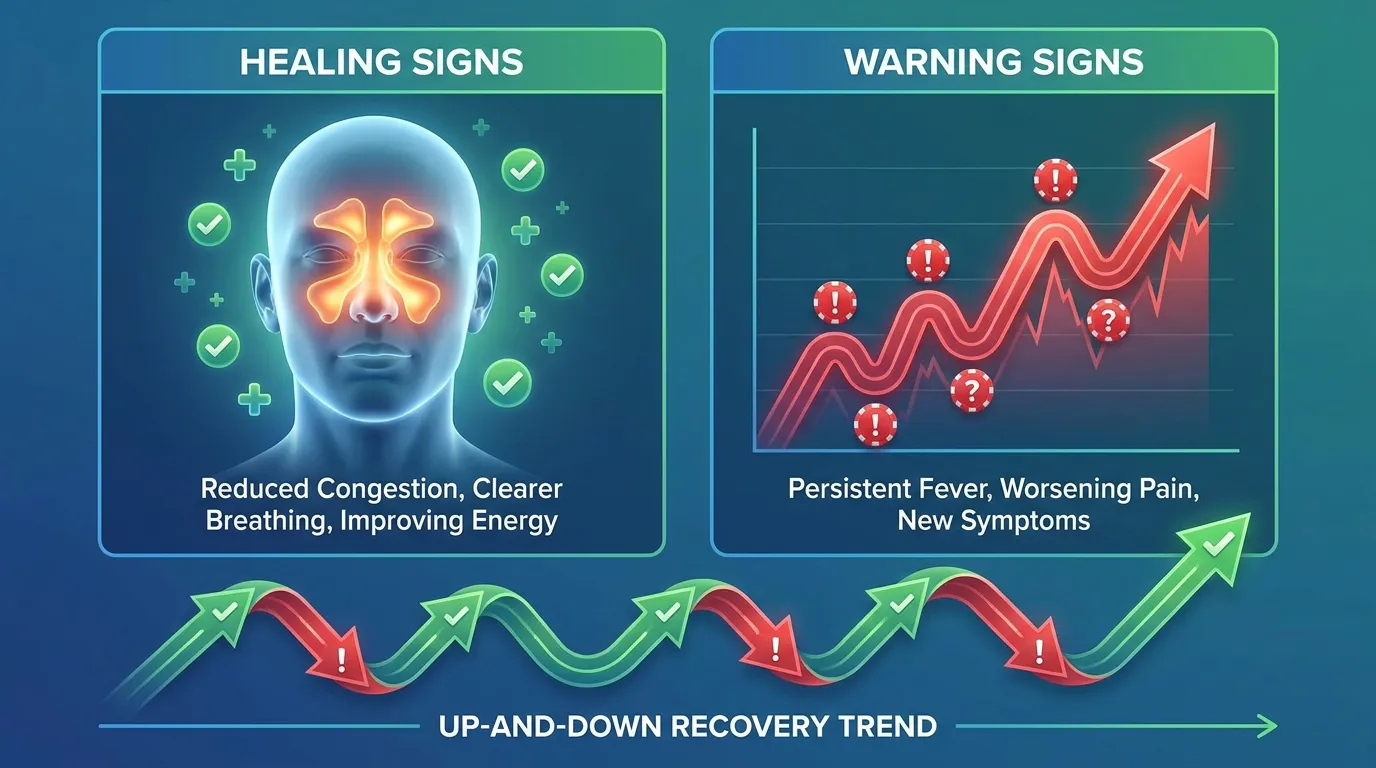
Red flags after any nasal procedure (when to contact your clinician urgently)
- Heavy bleeding that won’t slow
- Fever, worsening pain, significant swelling
- Severe headache or vision changes
Every procedure has trade-offs—ask about risks and realistic outcomes for you.
How to Decide Which Option Is Right for You (Decision Framework)
Step 1 — Confirm the real cause of obstruction
An ENT evaluation may include a nasal exam, nasal endoscopy, and sometimes imaging when sinus disease is suspected. If you’re debating procedures, ask your ENT to show you where the blockage is—septum, turbinates, valve area, inflammation, or a combination.
Step 2 — Match the procedure to the deviation’s severity and location
This is often the deciding factor:
- Front vs back of the nose
- Cartilage vs bone
- Presence of spurs or multi-plane deviation
Step 3 — Consider your schedule and recovery tolerance
Work demands, caregiving responsibilities, athletic schedules, and travel plans matter when comparing downtime. Even after initial downtime ends, subtle swelling can linger.
Step 4 — Consider what happens if a balloon-assisted approach doesn’t fully resolve symptoms
For some anatomies, balloon-assisted correction may be a stepping-stone; for others, traditional surgery is the more direct fix.
If you’re still unsure whether your symptoms fit, review these signs you may need a septoplasty:
- https://sleepandsinuscenters.com/blog/7-signs-you-need-a-septoplasty-when-to-see-an-ent-20260621153302
Questions to ask at your ENT consult
- Where is my deviation, and how severe is it?
- Do I also have turbinate enlargement or nasal valve collapse?
- What improvement should I realistically expect—and by when?
- What’s your plan if symptoms persist after treatment?
A focused exam is the fastest route to a confident choice.
Lifestyle Tips to Breathe Better Before and After Septal Procedures
Pre-procedure breathing/sleep tips (supportive)
- Saline rinses and/or humidifier use (especially in dry air)
- Allergen avoidance when relevant
- Sleep positioning that reduces nighttime stuffiness (such as head elevation)
Post-procedure comfort basics (general, non-prescriptive)
- Follow your clinician’s instructions closely
- Avoid nose blowing until you’re cleared
- Prioritize hydration and gentle nasal care as directed
Small daily habits can support easier breathing before and after treatment.
FAQs
Is a balloon-assisted septal technique as effective as septoplasty?
It depends on deviation type and location. Balloon-assisted methods may work well for carefully selected cases, while traditional septoplasty remains standard for complex deviations. (Cleveland Clinic; PMC)
- https://my.clevelandclinic.org/health/treatments/17779-septoplasty
- https://pmc.ncbi.nlm.nih.gov/articles/PMC6616214/
How long is recovery for septoplasty vs balloon-assisted techniques?
Many people plan around about a week of downtime after traditional septoplasty, while balloon-assisted approaches are often associated with shorter downtime—though experiences vary. (Cleveland Clinic)
- https://my.clevelandclinic.org/health/treatments/17779-septoplasty
Will septoplasty change the shape of my nose?
Septoplasty is intended to improve breathing internally, not change the external appearance—though individual anatomy and combined procedures can affect outcomes. (Mayo Clinic)
- https://www.mayoclinic.org/tests-procedures/septoplasty/about/pac-20384670
Can balloon-assisted septal remodeling be combined with other procedures?
Sometimes. Depending on findings, septal treatment may be combined with turbinate reduction or sinus procedures to address multiple sources of blockage.
What if my breathing is still blocked after surgery?
Early on, swelling can mimic blockage. Longer-term, persistent symptoms may relate to inflammation/allergies, turbinates, nasal valve issues, or residual deviation—follow-up helps clarify next steps.
Conclusion — The Most Appropriate Choice Depends on Your Anatomy
When comparing septoplasty vs balloon-assisted septal remodeling, the most appropriate option depends on your specific deviation and overall nasal anatomy:
- Balloon-assisted techniques: minimally invasive in select cases, sometimes office-based, may allow shorter recovery—appropriate for carefully selected deviations
- Traditional septoplasty: comprehensive correction for complex or severe cases and a durable structural solution
If you’re experiencing ongoing nasal obstruction and want clarity on your nasal septum surgery options, an in-person evaluation is the most reliable next step.
Call to Action
If you’d like to learn more or discuss your symptoms with an ENT, you can schedule an evaluation:
- https://sleepandsinuscenters.com/appointments
Medical disclaimer
This article is for general education only and isn’t a substitute for medical advice, diagnosis, or treatment. For personalized guidance, please consult a qualified clinician.
Sources
- Cleveland Clinic. Septoplasty. https://my.clevelandclinic.org/health/treatments/17779-septoplasty
- Mayo Clinic. Septoplasty. https://www.mayoclinic.org/tests-procedures/septoplasty/about/pac-20384670
- PubMed Central (PMC). Septoplasty outcomes study. https://pmc.ncbi.nlm.nih.gov/articles/PMC6616214/
- NSIBR. Balloon Septoplasty (provider educational material). https://nsibr.com/balloon-septoplasty/
- Breathe Freely. Balloon Septoplasty (provider educational material). https://breathefreely.com/balloon-septoplasty/
“This article is for educational purposes only and is not medical advice. Please consult a qualified healthcare provider for diagnosis and treatment.”
Don’t let allergies slow you down. Schedule a comprehensive ENT and allergy evaluation at Sleep and Sinus Centers of Georgia. We’re here to find your triggers and guide you toward lasting relief.