Septoplasty Anesthesia: General vs Local Options and What Most Patients Receive
If you’re scheduled for septoplasty, it’s natural to ask: what kind of anesthesia will I get—and what will it feel like? Below is a patient-friendly guide to common approaches to septoplasty anesthesia, why one option may be recommended over another, and what recovery is typically like.
A helpful way to think about it: septoplasty is delicate “carpentry” inside a small, sensitive space. Anesthesia isn’t just about comfort—it also helps the anesthesia team manage your breathing and airway more closely while keeping the surgical field steady for your surgeon.
Bottom line: anesthesia choice balances your comfort with a controlled, safe environment for your surgery.
Quick answer—what anesthesia do most septoplasty patients get?
Septoplasty is commonly performed under general anesthesia, meaning you’re fully asleep for the procedure. Major patient resources including MedlinePlus and Cleveland Clinic describe general anesthesia as a frequent approach for septoplasty:
- MedlinePlus: https://medlineplus.gov/ency/article/003012.htm
- Cleveland Clinic: https://my.clevelandclinic.org/health/treatments/17779-septoplasty

Why general is common
- Comfort: you’re not aware of the procedure.
- Airway management: the anesthesia team can more closely manage breathing and airway needs.
- Efficiency: it can be easier to keep the nose still and controlled during delicate work.
- Combining procedures: septoplasty is often done alongside other nasal procedures.
For example, if your septoplasty will be combined with turbinate reduction or sinus surgery, being fully asleep may make it easier to complete everything smoothly in one setting.
If you’re also exploring what to expect from deviated septum surgery, you can read more here: Deviated Septum Surgery at Sleep & Sinus Centers of Georgia: https://sleepandsinuscenters.com/blog/deviated-septum-surgery-at-sleep-sinus-centers-of-georgia
In many settings, general anesthesia is chosen because it works reliably across a wide range of patients and surgical scenarios.
Why septoplasty anesthesia choice matters (comfort, safety, recovery)
What patients usually care about:
- Will I feel anything?
- Will I remember anything?
- How long until I feel normal?
- Is one option safer?
- Will I have nausea or grogginess afterward?
Practical details are common concerns too, like a sore throat or early congestion. Many patients do feel congested after surgery, regardless of anesthesia type.
What your surgeon/anesthesia team considers:
- Procedure complexity and expected bleeding
- Whether other procedures are added (e.g., turbinate work or sinus surgery)
- Your medical history (sleep apnea, heart/lung conditions, anxiety, prior anesthesia reactions)
A good summary: the “best” anesthesia keeps you comfortable while giving the team the safest, most controlled conditions for your specific case.
Your plan is individualized to match the surgery and your health history.
Septoplasty basics (symptoms, causes, and when surgery is considered)
Septoplasty straightens the nasal septum (the “wall” between the two sides of the nose). It’s considered when a deviated septum contributes to persistent blockage or breathing issues.
Common symptoms that may lead to septoplasty:
- Nasal obstruction (often worse on one side)
- Mouth breathing, snoring, or poor sleep may occur in some patients
- Some people may also have facial pressure or recurrent sinus symptoms, though these are not specific to a deviated septum
- Nosebleeds or dryness (sometimes)
Common causes of a deviated septum:
- Prior nasal trauma (sports injuries, falls, accidents)
- Congenital/developmental asymmetry (present as the face grows)
When non-surgical treatment may be tried first:
- Saline irrigation, nasal steroid sprays, and allergy treatment (as appropriate)
For an overview of evaluation and options, visit Deviated Septum Relief: https://sleepandsinuscenters.com/deviated-septum-relief
Septoplasty primarily targets nasal obstruction from a deviated septum; improvements in snoring, sleep quality, or sinus symptoms are not guaranteed.

The 3 main anesthesia approaches for septoplasty
1) General anesthesia (common approach)
- You are fully unconscious, and your breathing is closely managed by the anesthesia team in an outpatient surgery center or hospital.
- Patient experience: you fall asleep, and the next thing you remember is waking up in recovery. Some people notice temporary grogginess, nausea, or a sore throat afterward (often from airway devices).
2) Septoplasty under local anesthesia (awake) with numbing medicine
- Numbing medicine is applied inside the nose (sprays/injections).
- You remain awake; calming medication may be used in selected cases.
- You should not feel sharp pain if the area is adequately numbed, but you may notice pressure, vibration, or sounds—similar to numb dental work.
3) Deep IV sedation with local anesthesia
- Combines IV sedatives with local numbing. You’re usually very drowsy and may not remember much, but this is not identical to full general anesthesia.
- Some studies suggest sedation-based approaches may reduce bleeding or postoperative discomfort in selected cases:
- Mayo Clinic: https://www.mayoclinic.org/tests-procedures/septoplasty/about/pac-20384670
- Campiglia et al. (2023) review: https://pmc.ncbi.nlm.nih.gov/articles/PMC10504799/
A simple way to picture sedation vs general: sedation makes you very sleepy, while general makes you fully unconscious; your team will choose the level that best fits your case.

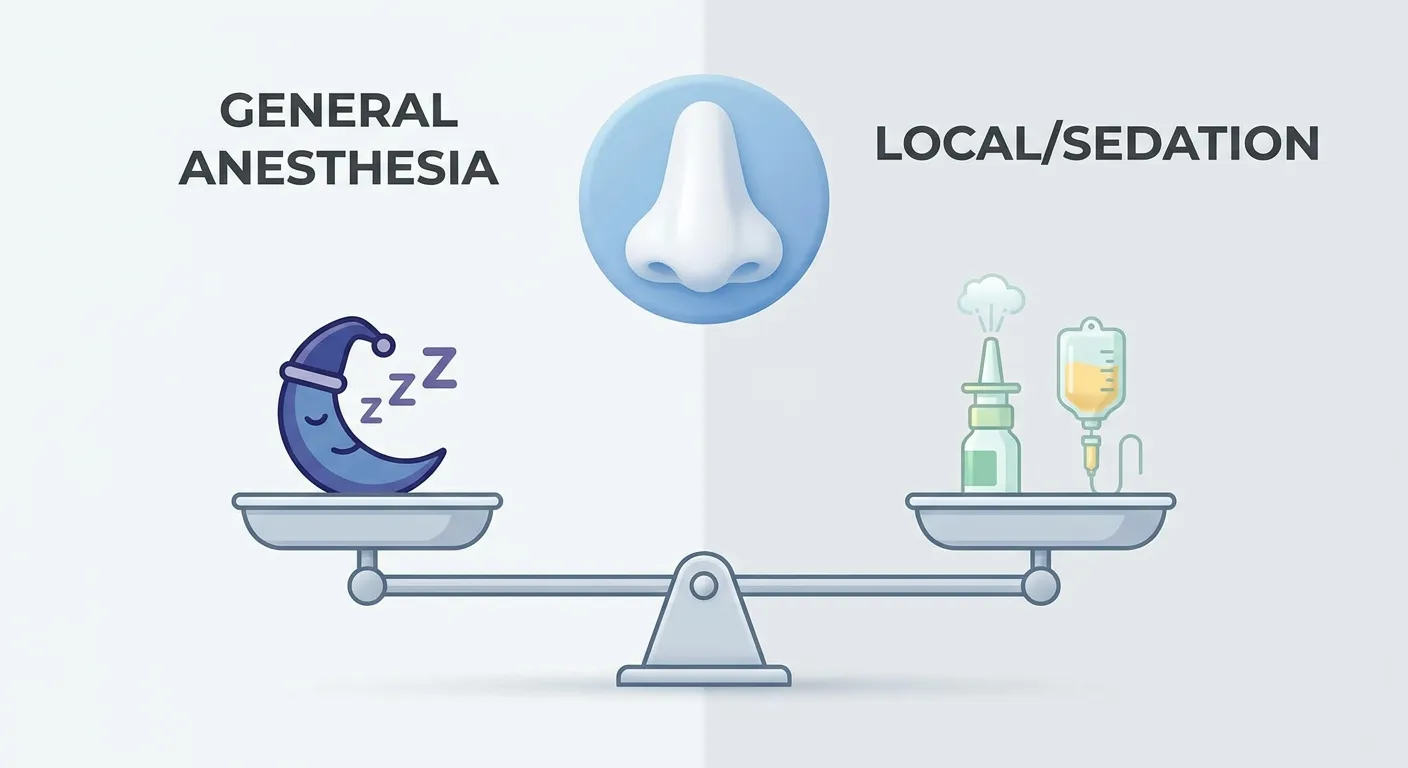
General vs local septoplasty anesthesia—practical comparison
General anesthesia
- During surgery: asleep; no awareness.
- Right after surgery: possible grogginess, nausea, or sore throat; sometimes longer time in the PACU (post-anesthesia care unit).
- Trade-offs: highly predictable comfort; often easier to combine procedures.
Local anesthesia (awake)
- During surgery: awake; pressure/vibration/sounds are possible; sharp pain is not expected if numbing is adequate.
- Right after surgery: often less of a “hangover” feeling.
- Trade-offs: some patients dislike awareness; anxiety tolerance matters.
Deep IV sedation with local anesthesia
- During surgery: very sleepy; often minimal memory of the procedure.
- Right after surgery: may have a quicker wake-up than general (varies).
- Trade-offs: requires careful monitoring and appropriate patient selection.
Bleeding and pain considerations:
- Some sedation + local protocols may reduce bleeding and early postoperative pain in selected cases, though experiences vary.
Patient satisfaction:
- Some studies have reported higher early satisfaction with general anesthesia than with local anesthesia in specific settings, but results are not universal:
- ENT & Audiology News review: https://www.entandaudiologynews.com/reviews/journal-reviews/post/septoplasty-under-local-and-general-anaesthetic
- Dogan et al. (2010): https://pubmed.ncbi.nlm.nih.gov/20498606/
Each option involves trade-offs; comfort, anxiety tolerance, and case complexity often guide the choice.

What research says about local anesthesia + dexmedetomidine
What is dexmedetomidine (plain-English):
- An IV sedative used in operating room and procedural settings. Dexmedetomidine may cause less respiratory depression than some other sedatives, but monitoring is still essential.
Potential benefits in septoplasty studies:
- Reduced surgical bleeding
- Lower postoperative pain
- PMC review: https://pmc.ncbi.nlm.nih.gov/articles/PMC6513247/
- Dogan et al. (2010): https://pubmed.ncbi.nlm.nih.gov/20498606/
Why it’s not standard everywhere:
- Facility protocols and monitoring requirements
- Case complexity and patient selection
- Surgeon and anesthesia team preferences and experience
Some centers use dexmedetomidine-based sedation for selected patients, but practice varies by team and setting.
Why general anesthesia is still a default for septoplasty
Even with alternatives available, general anesthesia remains widely used because it’s predictable and broadly applicable:
- Consistent comfort (no awareness or movement)
- Useful if bleeding is heavier than expected
- Efficient when combining procedures
- Many patients prefer to be fully asleep
This aligns with major patient resources:
- MedlinePlus: https://medlineplus.gov/ency/article/003012.htm
- Cleveland Clinic: https://my.clevelandclinic.org/health/treatments/17779-septoplasty
General anesthesia is often chosen not because local or sedation can’t work, but because general tends to work well across many scenarios.
Who might be a good candidate for local anesthesia or deep IV sedation?
Patients who may prefer or benefit:
- Strong preference to avoid being fully asleep (when appropriate)
- Shorter, straightforward septoplasty
- Comfortable being awake (for purely local)
Situations where general anesthesia may be recommended:
- High anxiety or difficulty tolerating nasal sensations
- More complex deviation or revision surgery
- Longer case expected
- Medical considerations where airway/ventilation control is a priority
Your team will match the anesthesia plan to your goals, anatomy, and overall health.

What to expect the day of surgery (step-by-step)
Before surgery:
- Fasting (NPO) timing instructions
- Which medications/supplements to pause (especially those affecting bleeding)
- What to report to anesthesia (prior nausea/vomiting after anesthesia, sleep apnea, allergies, past reactions)
In the operating room:
- Standard monitoring (heart rate, oxygen, blood pressure) and IV placement
- Even with general anesthesia, local numbing is often used in the nose to help with comfort and bleeding control.
Recovery room (PACU):
- Common impressions: nasal congestion/pressure, mild oozing, sleepiness (more likely after general or deeper sedation)
- Your team will ensure your breathing is comfortable, nausea is controlled, and your pain plan is working before discharge.
Expect more “stuffy” than “painful” sensations right after surgery, with steady improvement as swelling subsides.
Side effects and risks (anesthesia + septoplasty-related)
Common anesthesia-related side effects:
- General anesthesia: nausea/vomiting, sore throat, grogginess, chills/shivering
- Sedation: sleepiness, dizziness
- Local anesthesia: anxiety/discomfort from awareness; odd taste or temporary throat numbness from numbing medicine
Red flags after surgery (call your surgeon or seek urgent care):
- Heavy, uncontrolled bleeding
- Trouble breathing
- Chest pain, fainting, severe headache, or high fever
Normal annoyances like congestion or mild drainage are common; call promptly if symptoms feel severe or unusual to you.
Recovery tips that apply no matter which anesthesia you receive
First week comfort tips:
- Sleep with your head elevated
- Use saline sprays/rinses only if/when your surgeon approves
- Avoid heavy lifting/straining early on
- Stay hydrated; consider humidification for dryness
Sleep tips (especially if you snore or may have sleep apnea):
- Back sleeping with the head elevated is commonly recommended early on
- If you use CPAP, confirm timing and safety with your surgeon
For a detailed healing timeline, see Septoplasty Recovery Week-by-Week: https://sleepandsinuscenters.com/blog/septoplasty-recovery-week-by-week-complete-timeline-20260123051106
Simple home steps—like elevation, hydration, and approved saline—often make the first week smoother.
FAQs about septoplasty anesthesia
Will I be put to sleep for septoplasty?
- In many settings, yes—general anesthesia is common.
- MedlinePlus: https://medlineplus.gov/ency/article/003012.htm
- Cleveland Clinic: https://my.clevelandclinic.org/health/treatments/17779-septoplasty
Can septoplasty be done awake?
- Yes. Septoplasty under local anesthesia (with or without sedation) may be an option in selected cases.
Is local anesthesia safer than general?
- It depends on your health, airway considerations, and procedure complexity. Risks and benefits are individualized.
Will I feel pain during septoplasty under local anesthesia?
- You should not feel sharp pain if the area is adequately numbed, but you may notice pressure, vibration, or sounds.
What anesthesia has the fastest recovery?
- Some patients experience a quicker immediate recovery with sedation/local approaches, though results vary:
- Campiglia et al. (2023): https://pmc.ncbi.nlm.nih.gov/articles/PMC10504799/
Does anesthesia affect bleeding?
- Some studies suggest local anesthesia plus dexmedetomidine sedation may reduce bleeding:
- PMC review: https://pmc.ncbi.nlm.nih.gov/articles/PMC6513247/
- Dogan et al. (2010): https://pubmed.ncbi.nlm.nih.gov/20498606/
Discuss your specific risks and goals with your surgeon and anesthesia team for the most accurate guidance.
Questions to ask your surgeon/anesthesia team (checklist)
- Which anesthesia do you recommend for my case—and why?
- Will I have septoplasty alone or combined with other nasal procedures?
- What nausea prevention plan do you use?
- What is the post-op pain control plan?
- If I have sleep apnea or use CPAP, how does that affect the plan?
Arriving with a short question list can make your pre-op visit more productive and reassuring.
Call to action
If you’re exploring your options for septoplasty anesthesia (general anesthesia, deep IV sedation, or local), schedule a consultation with Sleep & Sinus Centers of Georgia: https://sleepandsinuscenters.com/appointments
Prefer to browse first? Start here: https://www.sleepandsinuscenters.com/ and, when you’re ready, book an appointment to review your symptoms, exam findings, and the safest anesthesia plan for your procedure.
Citations
- MedlinePlus. Septoplasty. https://medlineplus.gov/ency/article/003012.htm
- Cleveland Clinic. Septoplasty. https://my.clevelandclinic.org/health/treatments/17779-septoplasty
- Mayo Clinic. Septoplasty. https://www.mayoclinic.org/tests-procedures/septoplasty/about/pac-20384670
- Campiglia et al. (2023). https://pmc.ncbi.nlm.nih.gov/articles/PMC10504799/
- Dexmedetomidine/local anesthesia context (PMC). https://pmc.ncbi.nlm.nih.gov/articles/PMC6513247/
- Dogan et al. (2010). https://pubmed.ncbi.nlm.nih.gov/20498606/
- ENT & Audiology News review. https://www.entandaudiologynews.com/reviews/journal-reviews/post/septoplasty-under-local-and-general-anaesthetic
Disclaimer
This article is for educational purposes only and is not medical advice. Please consult a qualified healthcare provider for diagnosis and treatment.
Don’t let allergies slow you down. Schedule a comprehensive ENT and allergy evaluation at Sleep and Sinus Centers of Georgia. We’re here to find your triggers and guide you toward lasting relief.