Tympanometry Test Explained: ENT Ear Pressure Test for Middle Ear Problems
That lingering ear fullness after a cold, the pressure that will not “pop,” muffled hearing, or a stuffed sensation that allergies leave behind are some of the most common reasons people visit an ENT. When those symptoms persist, clinicians often reach for a tympanometry test—a quick, noninvasive “ear pressure test” that looks at how the eardrum moves and how the middle ear handles pressure, rather than measuring hearing itself.
Think of the eardrum as a small drumhead. For clear hearing and comfortable pressure, it needs to move freely. Fluid, congestion, or a hole can change that movement the way water or a tear would change a drum’s sound. Tympanometry maps that motion. The exam is generally painless. You may feel brief pressure or fullness while a device produces a tympanogram graph. Results are read together with a look in the ear (otoscopy) and a hearing test. Type A findings are often reassuring. Types B and C can suggest fluid, Eustachian-tube problems, a perforation, or blockage—depending on ear-canal volume and the rest of the exam. (Sources: Cleveland Clinic; ASHA; Interacoustics; AAFP; NCBI.)
Tympanometry offers a clear window into middle-ear mechanics when symptoms linger.
What Is Tympanometry and Why Do ENTs Recommend It?
Tympanometry is an acoustic-immittance test. It evaluates how the eardrum and middle-ear system respond to a tone and to changing air pressure. It does not directly measure hearing sensitivity. That distinction matters: a person can have a normal-looking eardrum movement pattern and still have hearing loss, or the reverse.
ENTs commonly order it when they suspect middle-ear fluid, Eustachian-tube dysfunction, an eardrum perforation, trouble regulating pressure, or when they need follow-up after infection or congestion. Those suspicions often line up with fullness, pressure, reduced or muffled hearing, popping, or problems that keep coming back. One clinician put it this way: “The graph tells us how the system is moving; the exam and history tell us why.” (Cleveland Clinic; ASHA.)
This test complements—not replaces—a full ENT exam and history.

How the Tympanometry Test Works (What to Expect)
Step-by-step procedure: An audiologist or ENT places a small, soft-tipped probe that seals the ear canal. The device then varies air pressure while playing a tone and records how much the eardrum moves and what the middle-ear pressure is. Those measurements appear as a tympanogram—a simple graph of compliance (movement) versus pressure. The peak of the curve, when present, shows the pressure at which the eardrum moves most easily.
Comfort, safety, and duration: Most people describe the tympanometry test as quick and noninvasive. Temporary pressure or fullness is common; sharp pain is not typical. Many patients say it feels a bit like the mild pop of an airplane descent, only shorter and milder. The whole process usually takes only a few minutes per ear and is generally considered safe in routine clinical use. Children often sit through it with little fuss once they know what to expect. (Cleveland Clinic; Interacoustics.)
The procedure is brief, safe, and usually well tolerated by both adults and children.


Understanding Tympanogram Results: Types A, B, and C
A tracing is never read in isolation. Clinicians combine it with ear-canal volume, otoscopy, and an audiogram. Tympanometry alone cannot diagnose every ossicular-chain problem and does not measure hearing.
Type A tympanogram: A Type A curve typically shows a peak near normal pressure with adequate eardrum movement. Picture a neat mountain peak centered on the graph. It generally points to normal middle-ear function and is often reassuring when it matches a healthy-looking exam.
Type B (flat) tympanogram: A flat Type B tracing means little or no measurable peak. With a normal ear-canal volume, that pattern may fit middle-ear fluid or other stiffness in the system—rather like trying to beat a waterlogged drum. With a large ear-canal volume, the same flat line can suggest a perforated eardrum (or an open ventilation tube), because the probe is measuring a bigger space. Volume plus what the clinician sees in the ear is what separates those possibilities. Fluid-related findings and next steps are discussed in more detail in our overview of chronic ear fluid and hearing changes: https://sleepandsinuscenters.com/blog/chronic-ear-fluid-and-hearing-loss-causes-symptoms-treatment.
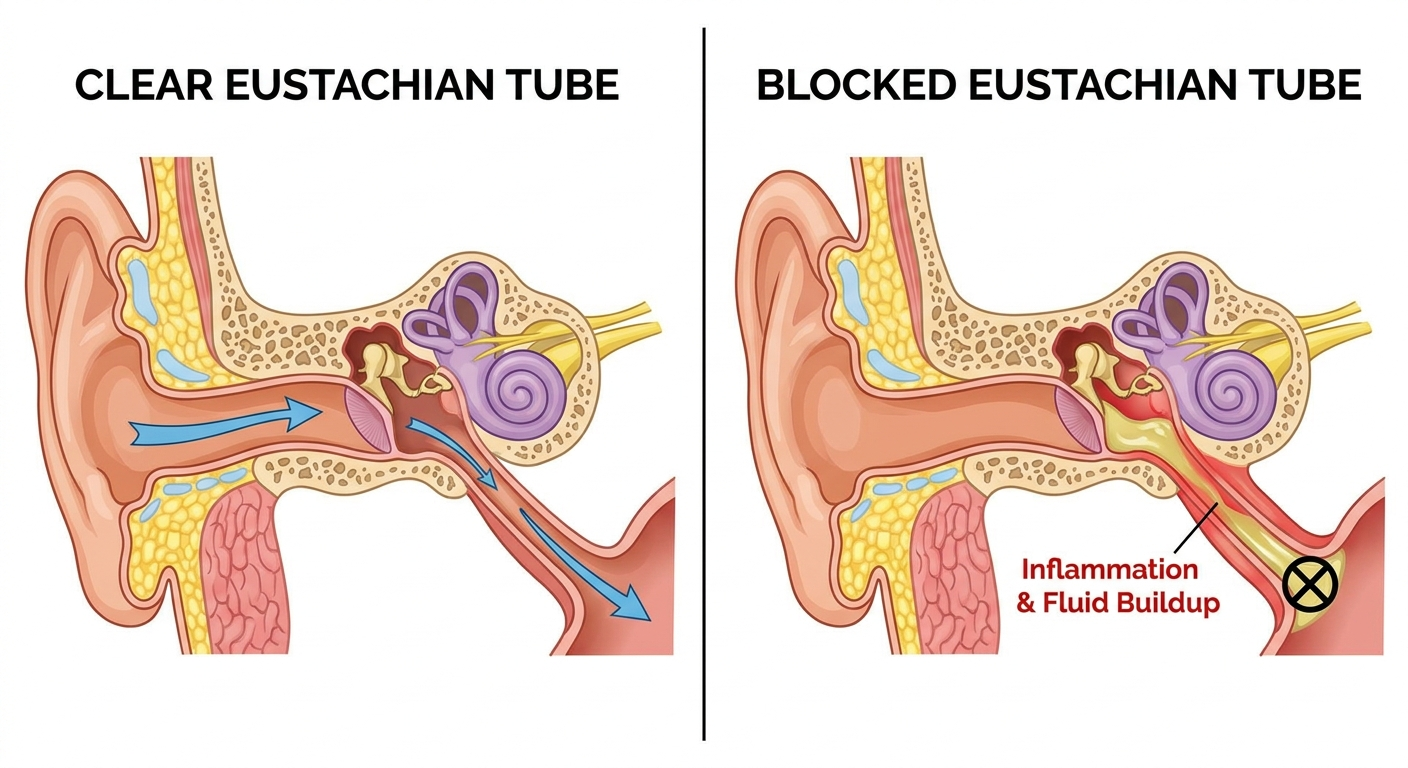
Type C tympanogram: A Type C graph shows a peak shifted toward unusually negative middle-ear pressure. That pattern is often linked to Eustachian-tube dysfunction, congestion, or recent infection—the tube is not equalizing pressure as expected, similar to a blocked straw that will not let air through. You can read more about that mechanism in our guide to Eustachian tube dysfunction: https://sleepandsinuscenters.com/blog/eustachian-tube-dysfunction-symptoms-causes-effective-treatment-options. (AAFP; ASHA; Cleveland Clinic.)
Patterns A, B, and C guide interpretation only when viewed with volume, otoscopy, and symptoms.
Limitations of Conventional Tympanometry
Because it does not measure hearing, a tympanometry test is paired with an audiogram when hearing is a concern. Conventional tympanometry is also considered unreliable in infants younger than about seven months. Their ear canals are highly compliant—almost too stretchy—so the tracing can be misleading. Very young children may need different techniques and always need complementary exams rather than a graph by itself. (ASHA; Interacoustics; NCBI.)
These limits underscore why the graph never stands alone.

Symptoms, Causes, and When an ENT Might Order Tympanometry
Common symptoms that lead to testing: People are often evaluated after ear fullness or pressure that will not equalize, muffled hearing, popping, discomfort after a cold or allergy flare, or suspicion of fluid that will not clear. A typical story: “My ears still feel stuffed two weeks after the sinus infection, and I keep trying to pop them.”
Underlying causes detected or suggested by abnormal results: Abnormal results may point toward middle-ear effusion (fluid), Eustachian-tube dysfunction, eardrum perforation, blockage, or pressure-regulation problems. Allergies, sinus congestion, and recent infections are frequent related factors. None of these labels come from the graph alone; they come from the full picture. (Cleveland Clinic; AAFP.)
Ongoing ear pressure or muffled hearing often prompts this simple test as part of a broader work-up.
What Happens Next? Treatments and Management After Abnormal Results
Tympanometry guides the next conversation; it is not a treatment. Depending on symptoms, how long they have lasted, ear-canal volume, and the exam, next steps may include watchful waiting, treating allergies or congestion, short-term use of nasal steroids or decongestants when appropriate, therapies aimed at the Eustachian tube, or, for persistent fluid, discussion of ear tubes—especially when problems are recurrent.
Root causes still matter: allergies, reflux, and structural issues are part of comprehensive ENT care rather than a single test result. Everyday habits that support nasal and sinus health—treating allergies promptly, using saline rinses as advised, avoiding flying or diving with active congestion, staying hydrated, and managing sinus symptoms—are often discussed as part of that bigger plan, not as a substitute for evaluation.
Follow-up care is tailored to the complete clinical picture, not the tympanogram alone.
Frequently Asked Questions About Tympanometry
Is the test painful? Usually no. Most people feel brief pressure or fullness.
How long does it take? It is very quick—typically a few minutes.
Can children have it? Yes, with important caveats for infants younger than about seven months, when conventional tracings can be unreliable.
Does a Type B or C always mean I need treatment? Not always. Interpretation depends on symptoms, ear-canal volume, otoscopy, and how long the problem has been present.
How often is it repeated? Timing varies. Clinicians may repeat it to track fluid, pressure, or recovery after treatment.
What if I have tubes or a perforation? A large ear-canal volume with a flat tracing can be consistent with an open tube or a hole in the eardrum; the exam and history put that finding in context.
Conclusion
A tympanometry test is a valuable, fast way to assess middle-ear mechanics, but it works best as one piece of a full ENT evaluation—together with looking in the ear and testing hearing. Type A is often reassuring; Types B and C invite a closer look at fluid, pressure, perforation, or Eustachian-tube function rather than a stand-alone diagnosis.
If ear pressure, fullness, or hearing changes are hanging on, an ENT visit can put the graph, the exam, and your symptoms together. To take the next step, you can learn more about comprehensive otolaryngology care: https://sleepandsinuscenters.com/comprehensive-otolaryngology-care, or book an appointment: https://sleepandsinuscenters.com/appointments with Sleep and Sinus Centers of Georgia.
Sources
Cleveland Clinic, “Tympanometry: Procedure Details & Results.” https://my.clevelandclinic.org/health/diagnostics/24222-tympanometry; ASHA Working Group on Aural Acoustic-Immittance Measurements, “Tympanometry.” https://www.asha.org/policy/rp1988-00027/; Interacoustics, “Tympanometry: An Introduction,” 2024. https://www.interacoustics.com/academy/tympanometry-training/traditional-tympanometry/tympanometry; American Academy of Family Physicians, “Tympanometry,” 2004. https://www.aafp.org/afp/2004/1101/p1713; NCBI, related clinical overview. https://www.ncbi.nlm.nih.gov/books/NBK556014/
This article is for educational purposes only and is not medical advice. Please consult a qualified healthcare provider for diagnosis and treatment.
Don’t let allergies slow you down. Schedule a comprehensive ENT and allergy evaluation at Sleep and Sinus Centers of Georgia. We’re here to find your triggers and guide you toward lasting relief.