How Long Is Deviated Septum Surgery? Septoplasty Duration and Recovery Time
Quick Answer: How long does septoplasty take?
Septoplasty typically takes 30–90 minutes, and more complex cases—especially when multiple procedures are done at the same time—can take 2–3 hours. Early swelling may begin improving within 2–3 days, many people can return to many normal activities within 1–4 weeks, and internal healing continues for months, with breathing improvements developing gradually for some patients over 2–12 months. (Sources: https://modalityllp.com/septoplasty-recovery-time/ ; http://drmatorin.com/the-patients-guide-to-septoplasty-and-turbinate-reduction-surgery ; https://entgasouth.com/blog/a-guide-resuming-normal-activities-after-septoplasty)
Some patients report the first week feels more congested and tiring than painful, though experiences vary.

Typical septoplasty time ranges (what patients can expect)
If you’re searching how long is deviated septum surgery, most septoplasties fall into a couple of common time ranges:
- Straightforward septoplasty: ~30–90 minutes
- More complex deviation / revision surgery / combined procedures: ~2–3 hours (Sources: https://modalityllp.com/septoplasty-recovery-time/ ; http://drmatorin.com/the-patients-guide-to-septoplasty-and-turbinate-reduction-surgery)
One simple example: someone needing only septum straightening may be closer to the shorter end, while someone combining septoplasty with turbinate reduction (or managing scar tissue from prior nasal surgery) may be closer to the longer end.
What is septoplasty (deviated septum surgery), and why it’s done
Septoplasty is surgery to straighten or reposition the nasal septum—the divider made of cartilage and bone that separates the left and right nasal passages. When it’s off-center (deviated), it can narrow airflow on one or both sides and contribute to ongoing nasal obstruction.
Think of the septum as the internal wall between your nostrils. A deviation means the wall is shifted or bent, sometimes with ridges (spurs) or curves that reduce space for air to move through comfortably. Many people have mild asymmetry without major symptoms; surgery is usually about function (breathing and airflow), not perfection.

Common symptoms of a deviated septum (and when surgery is considered)
A deviated septum doesn’t always need surgery. Septoplasty is typically considered when symptoms are persistent and affecting daily life, such as:
- Ongoing nasal blockage (often worse on one side)
- Trouble breathing through the nose—especially at night
- Snoring or sleep disruption
- Frequent congestion and facial pressure (which may overlap with allergy or sinus concerns)
- Recurrent nosebleeds or dryness (in some people)
If you’re weighing your options, a specialist evaluation can help clarify whether your symptoms are coming from the septum, swollen turbinates, nasal valve collapse, allergies, sinus disease—or a combination. Learn more about deviated septum treatment options: https://sleepandsinuscenters.com/deviated-septum-relief
Common causes of a deviated septum
- Natural development/asymmetry (many people are born with some degree of deviation)
- Injury or trauma (sports, falls, car accidents)
- Growth changes over time
Septoplasty aims to improve nasal function by creating a clearer airway; candidacy depends on your anatomy and symptoms.
What affects how long septoplasty takes?
When people ask how long does septoplasty take, the best answer is: it depends on your anatomy and the surgical plan.
Severity and complexity of the deviation:
- Significant S-shaped deviation
- Septal spurs
- Multiple contact points between the septum and internal nasal structures
Surgical exposure and approach: Most septoplasties are performed through an internal approach (incisions inside the nose). In select complex nasal reconstruction cases—often as part of broader procedures like septorhinoplasty—additional exposure may be needed, which can add operative time. (Sources for duration context: https://modalityllp.com/septoplasty-recovery-time/ ; http://drmatorin.com/the-patients-guide-to-septoplasty-and-turbinate-reduction-surgery)
Septoplasty alone vs combined procedures: It’s common to pair septoplasty with procedures that improve airflow. Combining procedures can increase total time because more than one anatomic issue is addressed in the same session. Common add-ons include:
- Turbinate reduction, if the turbinates are enlarged: https://sleepandsinuscenters.com/blog/everything-you-need-to-know-about-turbinate-reduction
- Sinus surgery, if chronic sinus disease contributes to symptoms
- Nasal valve repair, if nasal sidewall collapse is part of the blockage
Revision surgery, anatomy, and scar tissue: Revision cases (after prior nasal surgery) may take longer due to scar tissue and altered anatomy. Even without prior surgery, natural differences in cartilage strength and nasal structure can affect timing.
Procedure time varies based on anatomy, goals, and whether additional nasal issues are treated in the same session.
“Surgery time” vs “total time”: what the day looks like
Patients sometimes hear “the procedure is about an hour,” yet the day feels longer. That’s normal—procedure time is just one part of the timeline.
Pre-op preparation time at the facility—plan for:
- Check-in paperwork and consent
- Vital signs
- Pre-op instructions review
- Anesthesia team evaluation (if applicable)
Anesthesia and the in-room timeline may include:
- Anesthesia start and monitoring
- Positioning and sterile prep
- The procedure itself
- Waking up and initial observation
Recovery room and discharge time (outpatient expectations): Many septoplasties are outpatient, meaning you go home the same day. You’ll typically need a responsible adult to drive you home and stay with you early on.
Expect your total time at the center to exceed the actual procedure time.

Septoplasty recovery timeline (what heals when)
A helpful way to think about deviated septum surgery recovery is what you feel on the outside versus what’s happening internally as tissues remodel. For a deeper week-by-week view, see our guide: https://sleepandsinuscenters.com/blog/septoplasty-recovery-week-by-week-complete-timeline
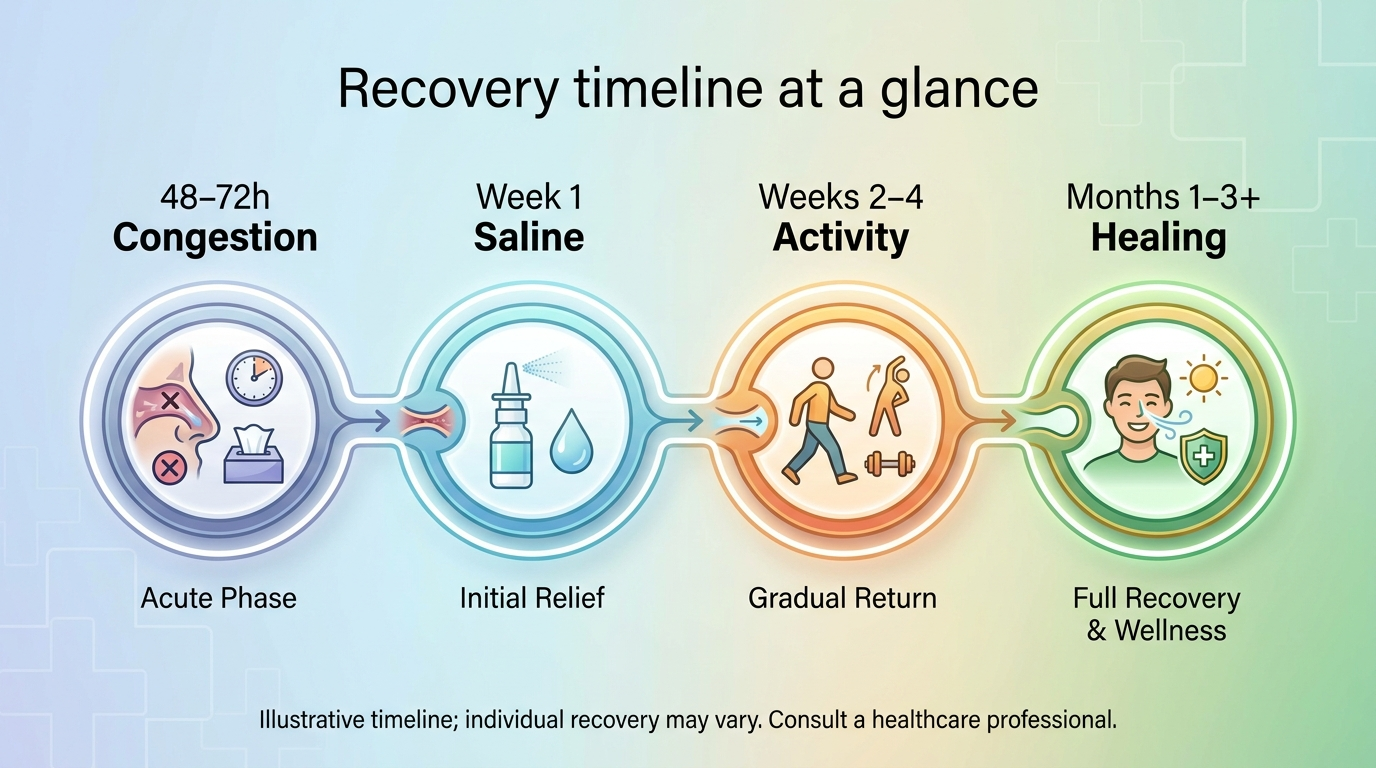
First 48–72 hours: swelling and congestion peak. In the first few days, many people notice:
- Significant stuffiness/congestion
- Pressure or fullness
- Mild bleeding or oozing
- Fatigue
Initial swelling may begin to improve within ~2–3 days, though congestion can linger due to internal swelling. (Source: https://modalityllp.com/septoplasty-recovery-time/)
Week 1: congestion, rinses, and early improvement (but not final results). Even if the septum is corrected, your nose may feel “blocked” early on because the lining tissues are swollen. Post-op care (often including saline rinses/sprays and activity limits) supports healing and comfort. Feeling congested in the first week does not necessarily mean the surgery didn’t help—healing is still early.
Weeks 2–4: back to regular activities for many patients. A common milestone is returning to many normal routines in this window—especially for non-strenuous daily tasks. Return-to-work timing varies by job demands and how you feel. (Source: https://entgasouth.com/blog/a-guide-resuming-normal-activities-after-septoplasty)
Months 1–3+: internal healing continues. Even after you feel “mostly normal,” deeper healing continues. Internal healing and swelling resolution can take several months. (Source: http://drmatorin.com/the-patients-guide-to-septoplasty-and-turbinate-reduction-surgery)
When will breathing feel “fully better”? Some people notice earlier improvement, while others feel changes step-by-step as swelling resolves and tissues settle. In some cases, breathing improvements continue to develop over ~2–12 months. (Sources: https://modalityllp.com/septoplasty-recovery-time/ ; http://drmatorin.com/the-patients-guide-to-septoplasty-and-turbinate-reduction-surgery)
Recovery usually unfolds in stages—early stuffiness improves first, while internal remodeling continues for months.
Tips to heal faster and feel better (lifestyle + aftercare)
This section is educational—not personal medical advice. Always follow the instructions provided by your surgical team.
Swelling reduction basics:
- Sleep with your head elevated (as directed)
- Stay well-hydrated
- Use humidified air in dry environments
Nasal care habits that support recovery:
- Saline rinses/sprays as directed
- Avoid irritants like smoke, strong fragrances, and dusty environments when possible
Activity and exercise tips (safe progression): Many patients start with gentle walking and gradually build back. More strenuous exercise is usually delayed until you’re cleared, since elevated heart rate and pressure can worsen swelling or trigger bleeding early on.
What to avoid during early healing (as directed by your surgeon):
- Nose blowing for a period of time
- Heavy lifting/straining
- Contact sports
- Certain medications or supplements that can affect bleeding (only change these with clinician guidance)
Gentle, consistent aftercare and avoiding irritants often support a smoother recovery.

When to call your surgeon (red flags)
Some symptoms are expected briefly after septoplasty, such as mild bleeding, congestion, and pressure. However, contact your care team urgently if you notice:
- Heavy bleeding that won’t stop
- Fever or worsening pain
- Foul-smelling drainage
- Vision changes, severe headache, or stiff neck
- Breathing difficulty that seems out of proportion to expected congestion
If something feels worrisome or out of proportion, call—earlier is better.
Treatment alternatives (if you’re not ready for surgery)
Not everyone needs surgery right away, and not all nasal obstruction is purely structural.
Non-surgical options that may help symptoms (depending on cause):
- Saline rinses
- Allergy evaluation and targeted treatment
- Nasal medications (as directed by a clinician)
- Nasal dilators/strips for temporary nighttime support
- Addressing turbinate swelling or rhinitis if those are major contributors
Less invasive or office-based approaches (when appropriate): In some cases, clinicians may discuss less invasive or office-based approaches, depending on anatomy and symptoms. Availability and suitability vary and should be reviewed with an ENT. Learn more: https://sleepandsinuscenters.com/blog/balloon-septoplasty-with-clearpath-a-less-invasive-fix-for-a-deviated-septum
An evaluation can clarify whether structural surgery, medical therapy, or a combination is most likely to help you.
FAQs
How long is deviated septum surgery from start to finish? The procedure itself often lasts 30–90 minutes, but can be 2–3 hours for complex cases. The total time at the facility is usually longer due to check-in, preparation, anesthesia, and recovery monitoring. (Sources: https://modalityllp.com/septoplasty-recovery-time/ ; http://drmatorin.com/the-patients-guide-to-septoplasty-and-turbinate-reduction-surgery)
Is septoplasty outpatient? Many septoplasties are outpatient, meaning you typically go home the same day. You’ll usually need someone to drive you home.
How long will I be swollen after septoplasty? Early swelling may begin improving within ~2–3 days, though internal swelling and congestion can take longer to settle. (Source: https://modalityllp.com/septoplasty-recovery-time/)
When can I return to work after septoplasty? It depends on what you do. Desk work may be possible sooner than physically demanding jobs. Many people can resume regular activities within 1–4 weeks, but your timing should reflect your surgeon’s guidance and how you’re healing. (Source: https://entgasouth.com/blog/a-guide-resuming-normal-activities-after-septoplasty)
When can I exercise again? Light activity (like walking) is often introduced earlier, while strenuous workouts are typically delayed until you’re cleared—especially to reduce bleeding and swelling risk.
When will I notice better breathing? Some improvement may be noticed earlier, but fuller results can be gradual. In some cases, breathing improvements may continue to develop over ~2–12 months as internal healing completes. (Sources: https://modalityllp.com/septoplasty-recovery-time/ ; http://drmatorin.com/the-patients-guide-to-septoplasty-and-turbinate-reduction-surgery)
Does septoplasty hurt? Some patients report more pressure and congestion than severe pain, especially in the first week, though individual experiences vary. Your care team may recommend comfort strategies and prescribe medications when appropriate.
Can septoplasty help snoring or sleep apnea? Improving nasal airflow may help some people with snoring or nasal breathing, but sleep apnea is often caused by multiple factors and usually requires separate evaluation. If sleep symptoms are part of your concern, you may find this helpful: https://sleepandsinuscenters.com/blog/can-a-deviated-septum-cause-sleep-apnea-symptoms-r-20260314181154
What do real patient experiences say? Online stories can be useful for general perspective, but recovery experiences vary widely based on anatomy, whether additional procedures were done, and individual healing patterns. It’s usually best to treat anecdotes as non-medical context rather than a prediction.
Conclusion: Planning for septoplasty with confidence
If you came here asking how long is deviated septum surgery, here are the most practical planning milestones:
- Surgery time: usually 30–90 minutes (up to 2–3 hours in complex cases)
- Early swelling: may begin improving in ~2–3 days
- Back to routine: often ~1–4 weeks for many activities
- Full healing/results: months, with breathing improvements sometimes evolving over 2–12 months (Sources: https://modalityllp.com/septoplasty-recovery-time/ ; http://drmatorin.com/the-patients-guide-to-septoplasty-and-turbinate-reduction-surgery ; https://entgasouth.com/blog/a-guide-resuming-normal-activities-after-septoplasty)
If you want a plan tailored to your anatomy, symptoms, and goals, book an appointment with Sleep and Sinus Centers of Georgia: https://www.sleepandsinuscenters.com/appointments
Plan for a short procedure and a longer healing arc, guided by your surgeon’s instructions.
Sources (clinical references)
- https://modalityllp.com/septoplasty-recovery-time/
- http://drmatorin.com/the-patients-guide-to-septoplasty-and-turbinate-reduction-surgery
- https://entgasouth.com/blog/a-guide-resuming-normal-activities-after-septoplasty
- https://subent.com/expertise/facialplastics/deviatedseptum/
Anecdotal reading (not a clinical reference)
- Patient discussion forum: https://www.reddit.com/r/SleepApnea/comments/ra6xlj/can_someone_share_their_recovery_experience_from/
This article is for educational purposes only and is not medical advice. Please consult a qualified healthcare provider for diagnosis and treatment.
Don’t let allergies slow you down. Schedule a comprehensive ENT and allergy evaluation at Sleep and Sinus Centers of Georgia. We’re here to find your triggers and guide you toward lasting relief.