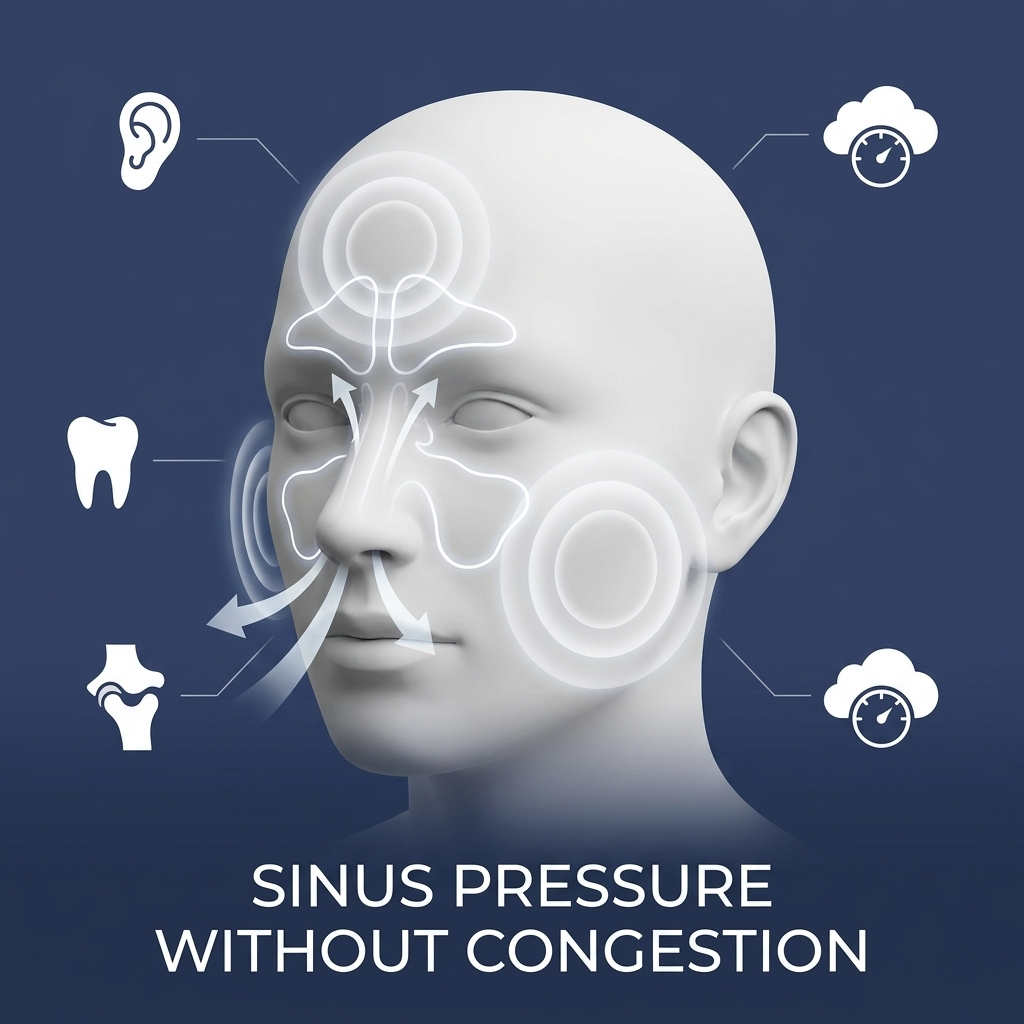
Sinus Pressure Without Congestion: Causes, Symptoms, and Relief Options
Feeling “sinus pressure” but still being able to breathe through your nose normally can be confusing—and frustrating. Many people assume it must be a sinus infection. The good news: this is common, and it does not necessarily mean sinusitis or that antibiotics are needed.
Below is a patient-friendly guide to sinus pressure without congestion, including what it can feel like, the most common (and most missed) causes, safe at-home comfort options, and when to see an ENT.
Quick Answer: Can You Have Sinus Pressure Without Congestion?
Yes. Sinus pressure without congestion can happen, and not all facial pressure is sinusitis. Nasal congestion refers to swelling inside the nose that can block airflow—so it’s possible to have “pressure” sensations even when airflow feels normal (definition overview here: https://www.mayoclinic.org/symptoms/nasal-congestion/basics/definition/sym-20050644).
Why this matters: facial pressure symptoms overlap with headache disorders, ear pressure problems, TMJ, and dental issues. When the cause isn’t a bacterial sinus infection, treating it like one can lead to ineffective antibiotics and longer discomfort.
A simple way to think about it: pressure sensations are a symptom—not a diagnosis. The job is to figure out which system (sinuses, ears, jaw, teeth, nerves) is actually driving the sensation.
• In short: not all “sinus pressure” comes from the sinuses themselves.

What “Sinus Pressure” Feels Like (Even When You Can Breathe Normally)
Common sensations patients describe
- Pressure behind the eyes or in the forehead
- Cheek pressure or upper jaw heaviness
- Fullness around the bridge of the nose
- Head heaviness that feels worse when bending forward
- Ear fullness, popping, or muffled hearing (often not actually a sinus issue)
A few “real life” descriptions clinicians hear:
- “My face feels like it’s in a vise, but my nose is totally clear.”
- “It’s like a dull bruise under my eyes.”
- “My ears won’t ‘equalize,’ and then my cheeks start aching.”
Where you feel it can hint at the cause
- Forehead: frontal sinus region vs. tension-type headache
- Cheeks/upper teeth: maxillary sinus region vs. dental pain or TMJ-related facial pain
- Around/behind the eyes: migraine, cluster-type headaches, or sinus inflammation
One helpful rule of thumb: if the discomfort keeps returning in the same pattern (for example, always with storms, always with stress, or always after chewing), that pattern often points away from infection and toward a trigger-based condition like migraine physiology, jaw tension, or ear pressure/equalization issues.
• Bottom line: pay attention to patterns—what triggers and relieves the pressure can be a big clue.
Symptoms to Watch For
Typical symptoms that can occur without congestion
- Facial pressure or tenderness
- Headache
- Ear pressure/popping
- Mild post-nasal drip (sometimes)
- Fatigue or “brain fog” (very nonspecific)
These symptoms can be uncomfortable but are not, by themselves, proof of infection.
Symptoms that may suggest sinus inflammation
- Reduced sense of smell
- Thick drainage (from the nose or down the throat)
- Symptoms that started with a cold and then persist or worsen afterward
If you think, “I had a classic cold, felt like I was getting better, and then the facial symptoms ramped up again,” that timeline may be more consistent with sinus inflammation than a primary headache disorder—though overlap is still possible.
Red flags (seek urgent care)
- High fever or severe facial swelling
- Vision changes or severe eye pain
- Confusion, stiff neck, or neurological symptoms
- Sudden “worst headache,” fainting, weakness
For general guidance on when to seek urgent help with sinus symptoms, see the NHS sinusitis page: https://www.nhs.uk/conditions/sinusitis/.
• Key point: if symptoms are severe, rapidly worsening, or involve vision or neurological changes, seek urgent care.
Causes of Sinus Pressure Without Congestion (Most Common to Most Missed)
Many cases of “sinus pressure” are actually referred pain (pain felt in the sinus area but originating elsewhere) or involve pressure/equalization sensitivity—not blocked sinuses.
1) Referred pain (pain felt in the “sinus area” from elsewhere)
The face, teeth, jaw, and sinuses share overlapping nerve pathways. That shared “wiring” can make pain from one area feel like it’s coming from another—one reason sinus pain without a stuffy nose can still feel very real.
Think of referred pain like a house with shared electrical circuits—when one switch is acting up, the “problem” can seem like it’s in a different room.

2) Eustachian Tube Dysfunction (ETD)
ETD commonly causes:
- Ear pressure/fullness
- Popping or crackling
- Muffled hearing
- Discomfort with altitude changes (driving in mountains, flying)
Because ear pressure can radiate into the face, ETD may be mistaken for sinus trouble. Some patients notice, “My ears feel clogged first, and then my face starts to ache.” If this matches your symptoms, ear pressure and popping may be Eustachian tube dysfunction (ETD): https://sleepandsinuscenters.com/blog/eustachian-tube-dysfunction-symptoms-causes-effective-treatment-options
3) Mild sinus inflammation (without major blockage)
Sometimes the sinus lining is irritated or inflamed without significant obstruction—so breathing still feels okay. Triggers can include:
- Early viral illness
- Allergies
- Smoke, strong fragrances, pollution, or other irritants
This can create pressure even before you develop noticeable drainage. In other words, the tissue can be “angry” without being “plugged.”
4) Dental causes (especially upper teeth) and oral infections
Upper tooth roots sit close to the maxillary sinuses. Dental issues may cause:
- Cheek pressure
- Pain that worsens with chewing
- Sensitivity to hot/cold
- A “one-sided” facial ache that feels sinus-related
A concrete clue: if the discomfort is clearly one-sided and you can point to a specific tooth—or if chewing reliably triggers symptoms—a dental source deserves a closer look.

5) TMJ disorder / jaw muscle tension
Clenching, grinding, or jaw joint irritation can mimic sinus discomfort. Clues include:
- Jaw clicking or locking
- Morning jaw soreness
- Temple headaches
- Cheek tightness that feels like pressure
This is a common explanation for facial pressure without congestion—especially during stress or poor sleep.

6) Barometric pressure changes (“weather headaches”)
Some people get pressure symptoms when the weather shifts, during storms, or with altitude changes. This is often described as a barometric pressure headache and can overlap with migraine physiology. Learn more: https://sleepandsinuscenters.com/blog/barometric-pressure-headaches-and-sinus-relief-causes-treatment
7) Headache disorders commonly mistaken for sinusitis
Many “sinus headache” complaints are ultimately due to primary headache disorders, not infection. A clinical review discusses this overlap and why it matters for treatment: https://pmc.ncbi.nlm.nih.gov/articles/PMC7752074/
Common look-alikes:
- Migraine: facial pressure, light sensitivity, nausea, smell sensitivity; can include watery eyes or runny nose
- Tension-type headache: band-like pressure, scalp/neck muscle tension
- Trigeminal autonomic cephalalgias (TACs): severe one-sided pain with tearing/red eye and nasal symptoms (new or severe symptoms merit prompt evaluation)
If you’re trying to sort out sinus headache vs. migraine, this explainer may help: https://sleepandsinuscenters.com/blog/migraine-vs-sinus-headache-key-differences-and-symptoms-explained
• Takeaway: the “cause” of pressure is often outside the sinuses—ears, teeth, jaw, and headache disorders are frequent drivers.
How to Tell If It’s Sinusitis vs. Something Else (Patient-Friendly Checklist)
Signs it may not be a sinus infection
- No thick drainage
- No fever
- A headache pattern that matches migraine or tension headache
- Recurrence with weather shifts (a barometric pressure headache pattern)
- Tooth pain with chewing or temperature sensitivity
- Jaw clicking/clenching symptoms (possible TMJ-related referral)
If you’ve had multiple “sinus infection” diagnoses but rarely have mucus, blockage, or smell changes, it may be worth asking a clinician to reassess the diagnosis.
Signs you should consider ENT evaluation
- Symptoms persist beyond about 7–10 days, keep recurring, or disrupt daily life
- Pain is progressive or changing
- You’ve tried reasonable home comfort measures without improvement
Depending on your history, evaluation may include a nasal exam, discussion of allergies, and sometimes imaging when indicated (not automatically).
• Guiding idea: match the treatment to the true driver of symptoms, not just the location of the pain.

Safe At-Home Relief Options (Start Here)
When you’re dealing with sinus pressure without congestion, conservative comfort care is often a reasonable first step.
Warm compress + steam for comfort
- Try a warm, moist compress over the cheeks/forehead for 10–15 minutes.
- Steam from a warm shower may temporarily reduce the “tight” pressure feeling. Use steam carefully to avoid burns.
OTC pain relief (use thoughtfully)
Over-the-counter pain relievers may help some people, but follow label directions and check with a clinician if you have medical conditions, take other medications, or are pregnant/breastfeeding. If headaches are frequent, know that overusing pain relievers can sometimes make headaches more persistent—ask a clinician if you’re needing them often.
Saline irrigation (do it safely)
Saline rinses can help wash out irritants and thin mucus—even if you’re not very congested.
Important safety note: Use only distilled/sterile water, or water that’s been boiled and cooled. Neti pot guidance: https://health.clevelandclinic.org/what-are-neti-pots-and-do-they-work
Hydration + humidification
- Staying hydrated may help some people feel more comfortable and may help secretions stay less irritating.
- If indoor air is dry, a clean humidifier may improve comfort (especially at night).
- Sleep environment and positioning can also make a difference; supportive tips: https://www.healthline.com/health/how-to-sleep-with-a-stuffy-nose
TMJ self-care (if jaw symptoms are present)
- Consider a temporary soft-food break and avoid gum
- Use gentle heat over jaw muscles
- A dental conversation about clenching/grinding (and whether a night guard is appropriate) can be useful
A simple daytime check-in can help: relax your jaw so your teeth aren’t touching (“lips together, teeth apart”).
• Start simple: comfort measures and safe self-care can meaningfully reduce symptoms for many people.
Medical Treatments (What a Clinician Might Recommend—Depending on Cause)
Treatment depends on the driver of the pressure—especially if your “sinus” symptoms are actually migraine, ETD, or TMJ.
If allergies or inflammation are suspected
- Intranasal steroid sprays (technique matters)
- Non-sedating antihistamines (when allergy-driven)
- Allergy evaluation for recurrent/seasonal symptoms
If ETD is suspected
Management often focuses on addressing underlying nasal inflammation/allergies and safe pressure-equalizing strategies, with follow-up if symptoms persist.
If migraine or primary headache disorder is suspected
Migraine-directed care (acute treatments, prevention options, trigger management) can be more effective than repeated “sinus” treatments. The facial pain overlap is well described here: https://pmc.ncbi.nlm.nih.gov/articles/PMC7752074/
If dental/TMJ cause is suspected
A dental exam (and imaging when appropriate) can identify tooth or bite-related issues. TMJ-focused care may include bite support, physical therapy, and habit changes.
Why antibiotics often don’t help in these cases
Antibiotics don’t treat migraine, TMJ disorders, ETD, or noninfectious inflammation. When sinus pressure without congestion is misread as infection, antibiotics may offer little benefit—another point emphasized in facial pain/sinus overlap research: https://pmc.ncbi.nlm.nih.gov/articles/PMC7752074/
• Principle: target the treatment to the cause—antibiotics help bacterial infections, not pressure from other sources.
When to See a Doctor (and When to See an ENT)
Make an appointment if:
- Pressure lasts more than about 7–10 days, is recurrent, or disrupts sleep/work
- Symptoms are worsening or unusual for you
- You suspect dental pain, TMJ, or migraine but aren’t sure
If you can, bring a quick “symptom timeline” (when it started, what seems to trigger it, what relieves it). That context often speeds up an accurate diagnosis.
ENT referral is especially helpful when:
- Symptoms continue despite appropriate home care
- You’ve had repeated “sinus” complaints with minimal drainage or blockage
- A focused evaluation is needed to clarify diagnosis and next steps
To get help sorting this out, you can schedule an ENT evaluation: https://sleepandsinuscenters.com/appointments
• If symptoms are persistent, changing, or confusing, a focused evaluation can save time and reduce trial-and-error.
Lifestyle & Prevention Tips (Reduce Recurrence)
Manage triggers
- Weather shifts: plan ahead with hydration, steady sleep, and timely symptom-management steps (especially if storms trigger symptoms)
- Irritants: reduce smoke exposure, strong fragrances, and address dust/mold when possible
Sleep and posture strategies
- Slight head elevation may reduce the sense of pressure when lying down
- A consistent sleep schedule can lower headache susceptibility for many people
Jaw habits
- Reduce daytime clenching (a relaxed “lips together, teeth apart” resting posture can help)
- Stress management matters—jaw tension often tracks with stress load
• Small, consistent habits often make the biggest difference over time.
FAQs
Why do my sinuses hurt when I’m not congested?
Because facial pressure can come from ETD, migraine, TMJ, dental problems, or mild inflammation—not only from blocked sinuses. This is a common reason people experience sinus pain without a stuffy nose.
Can a migraine feel like sinus pressure?
Yes. Migraine can present as facial pressure and may include nasal or eye symptoms. Correctly identifying sinus headache vs. migraine can change treatment choices significantly (review: https://pmc.ncbi.nlm.nih.gov/articles/PMC7752074/).
Is it safe to use a neti pot if I’m not congested?
It can be used for comfort and irritant clearance, but safe technique matters. The key is using sterile/distilled or boiled-then-cooled water (safety guidance: https://health.clevelandclinic.org/what-are-neti-pots-and-do-they-work).
When is facial pressure an emergency?
Seek urgent care for vision changes, severe swelling, high fever, confusion, stiff neck, neurological symptoms, or a sudden “worst headache.” General guidance: https://www.nhs.uk/conditions/sinusitis/
What if this keeps happening every time the weather changes?
That pattern may fit a barometric pressure headache or migraine biology more than sinus infection. A headache-focused discussion (rather than repeated antibiotics) is often more productive. Learn more about weather-related pressure: https://sleepandsinuscenters.com/blog/barometric-pressure-headaches-and-sinus-relief-causes-treatment
Conclusion: The Best Relief Starts With the Right Diagnosis
Sinus pressure without congestion is real—but it isn’t always caused by infected sinuses. ETD, migraine, TMJ tension, dental problems, and weather-related headaches can all create pressure behind the eyes with no congestion or broader facial pressure without congestion.
A stepwise approach usually works best: start with conservative comfort care, then pursue targeted evaluation if symptoms persist, recur, or don’t match typical sinus inflammation patterns.
If you’d like help getting clarity, you can book an appointment with Sleep and Sinus Centers of Georgia here: https://sleepandsinuscenters.com/appointments. You can also learn more at https://www.sleepandsinuscenters.com/.
“This article is for educational purposes only and is not medical advice. Please consult a qualified healthcare provider for diagnosis and treatment.”
Don’t let allergies slow you down. Schedule a comprehensive ENT and allergy evaluation at Sleep and Sinus Centers of Georgia. We’re here to find your triggers and guide you toward lasting relief.