Nasal Polyps vs Deviated Septum: Symptoms, Key Differences, and Treatment Options
Introduction — Why These Two Conditions Get Confused
A “stuffy nose” seems simple—until it isn’t. Two common reasons people feel blocked up are nasal polyps and a deviated septum, and they can look similar day-to-day: nasal obstruction, mouth breathing, snoring, and sleep disruption.
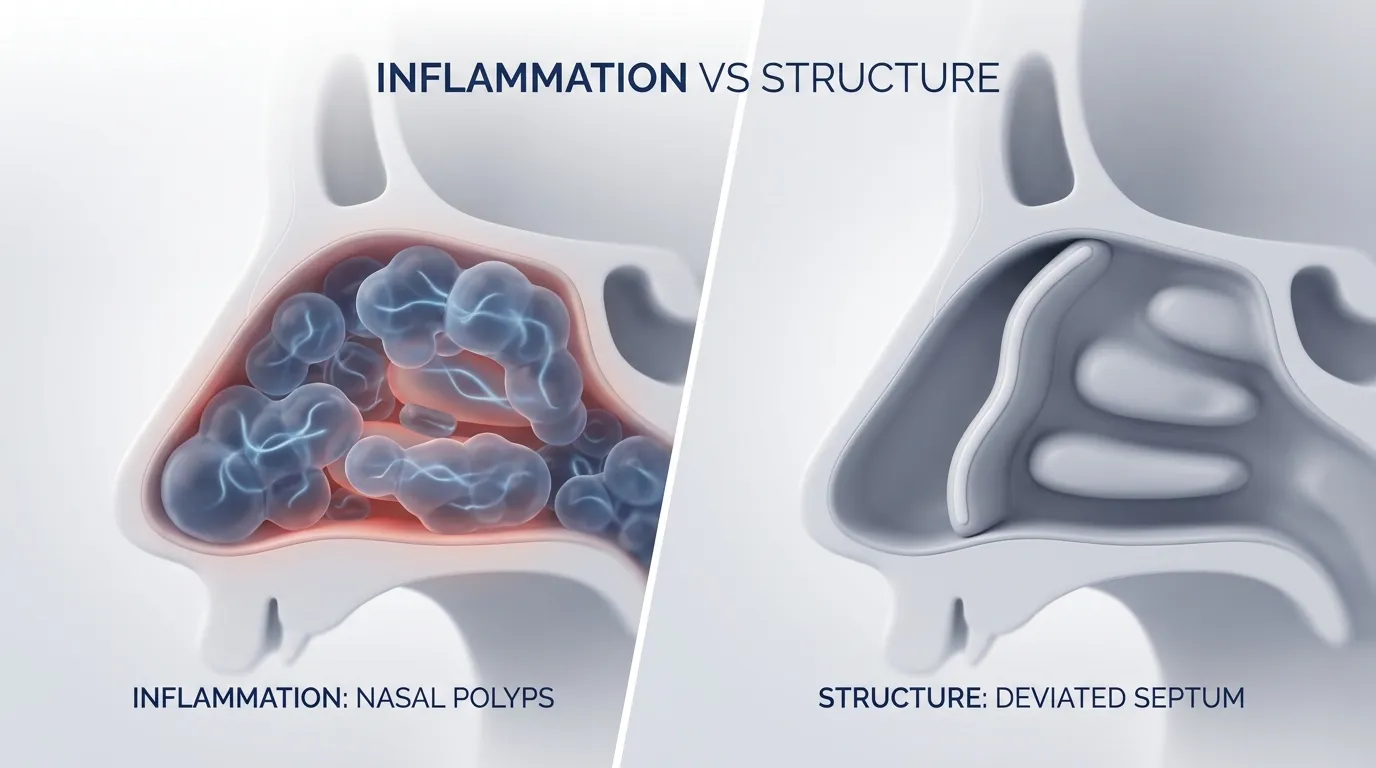
The key reason the confusion matters is that these conditions stem from different problems—and that drives treatment choices. In general, nasal polyps are typically an inflammatory condition, while a deviated septum is a structural issue. Understanding the difference helps you know what questions to ask and what evaluations may be helpful. (Mayo Clinic, 2025; Cleveland Clinic, 2024) [1][2]
A helpful way to think about it: inflammation is like swelling that narrows a hallway, while a septal deviation is like the hallway wall being built off-center. Both can block traffic, but you solve them differently.
Summary: It’s inflammation vs structure—and that difference guides treatment choices.
Quick Summary — Nasal Polyps vs Deviated Septum (At-a-Glance)
One-sentence definition of each
- Nasal polyps: soft, painless inflammatory growths in the nasal lining or sinuses. (Cleveland Clinic, 2024; AAAAI) [2][5]
- Deviated septum: the cartilage/bone wall between nostrils is off-center, narrowing airflow through one or both sides. (Mayo Clinic, 2025) [1]
If you want a deeper overview of what nasal polyps are, see: https://sleepandsinuscenters.com/blog/what-are-nasal-polyps
Core difference that drives treatment
- Polyps often respond to steroid medications and, when symptoms persist or recur, endoscopic sinus surgery (FESS), often with polyp removal. [2][5]
- A deviated septum typically needs septoplasty to correct the structure; sprays and other meds may reduce swelling but won’t straighten cartilage or bone. (Mayo Clinic, 2025) [1]
Summary: Polyps often improve with anti-inflammatory therapy; a deviated septum usually requires structural correction.
What Causes Nasal Polyps?
Inflammation and underlying triggers
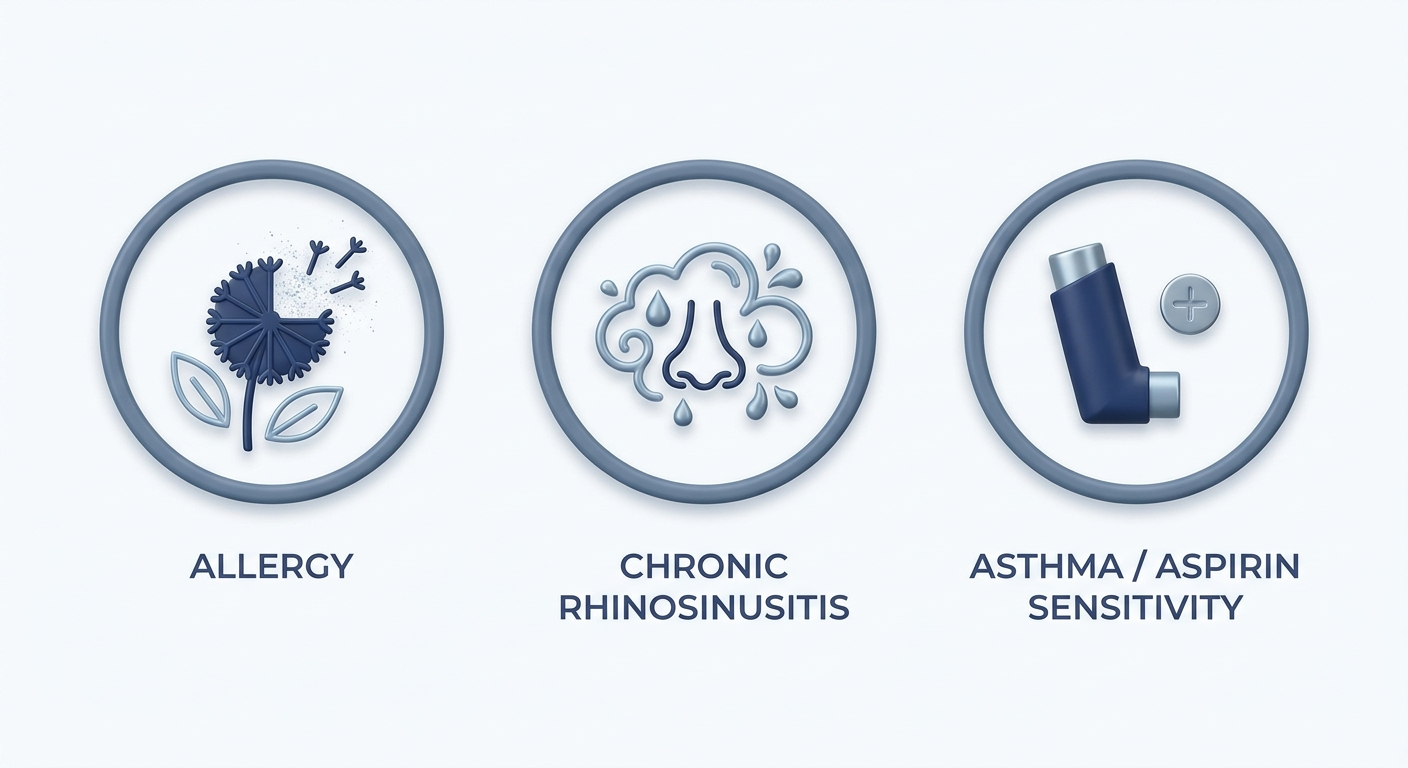
Nasal polyps are most often tied to chronic inflammation in the nose and sinuses. Conditions associated with polyp development include:
- Allergic rhinitis and other allergy patterns
- Chronic rhinosinusitis
- Asthma and aspirin sensitivity (often discussed in AERD contexts) (AAAI; Cleveland Clinic) [2][5]
In plain terms: when the nasal lining stays irritated for a long time, the tissue can become persistently swollen—and in some people, that swelling can form polyp tissue. Not everyone with allergies or sinus inflammation gets polyps, but the overlap is common enough that clinicians routinely ask about it. [2][5]
Who is more likely to develop nasal polyps?
People with ongoing nasal/sinus inflammation—especially those with long-term symptoms that don’t fully clear—may be more likely to develop polyps. (AAAI) [5]
Common nasal polyps symptoms include persistent congestion, reduced smell, and postnasal drip—often lasting for weeks or months rather than days. [2][5]
A “real life” example
You might notice you’ve been congested for so long that you can’t remember what “clear breathing” feels like, and your sense of smell fades gradually. That slow, stubborn pattern is one reason clinicians often consider inflammation-based causes like polyps. [2][5]
Summary: Long-standing, smell-affecting congestion often points to inflammation, including possible polyps.
What Causes a Deviated Septum?
Genetics vs injury
A deviated septum is common. Many people are born with a deviation or develop one as the nose grows. Others develop a deviation after trauma such as:
- Sports injuries
- Falls
- Accidents (Mayo Clinic, 2025) [1]
Sometimes the injury is obvious (“I got hit in the nose”), and sometimes it’s easy to forget (“I fell years ago and never thought much about it”). Either way, the result can be an airway that’s physically narrower on one side. [1]
Why a structural issue matters
Because the issue is physical narrowing, medications may reduce surrounding swelling but cannot fix the deviation itself. (Mayo Clinic, 2025) [1] This is one of the most important distinctions in nasal polyps vs deviated septum comparisons.
A simple analogy: if a doorframe is crooked, oiling the hinges may reduce squeaks (symptoms), but it won’t straighten the frame (structure).
Summary: If the passage is built off-center, only a structural correction can truly straighten it.

Symptoms — What You Might Feel (And What’s Similar)
Symptoms both conditions can share
Both can contribute to nasal obstruction causes that feel frustratingly similar:
- Nasal congestion/blocked nose
- Mouth breathing
- Reduced sense of smell
- Snoring or sleep disruption
- Postnasal drip and pressure (varies by person) (Mayo Clinic, 2025; Cleveland Clinic, 2024) [1][2]
Because the day-to-day symptoms overlap, people often try the same fixes—steam, sprays, rinses—without knowing which problem they’re actually dealing with. That’s normal, and it’s one reason a targeted exam can be so useful. [1][2]
Symptoms more suggestive of nasal polyps
These patterns lean more toward polyps (though only an exam can confirm):
- Congestion that feels “deep” and persistent
- Reduced smell/taste (often prominent)
- Often affects both sides (bilateral) (Cleveland Clinic, 2024; AAAAI) [2][5]
Symptoms more suggestive of deviated septum
These patterns can sound more like a septum issue:
- One side consistently worse than the other
- Feeling like you “can’t breathe through one nostril,” often worse at night
- Some people experience dryness or nosebleeds (Mayo Clinic, 2025) [1]
A quick “pattern check” you can notice at home
- If one nostril is almost always the trouble side, a structural narrowing may be part of the story. [1]
- If symptoms are persistent and more global, especially with smell changes, inflammation (including polyps) is often considered. [2][5]
These are clues—not diagnoses.
Summary: Side-dominant blockage hints at structure; bilateral, smell-affecting patterns suggest inflammation—an exam confirms the cause.
Key Differences (Patient-Friendly Comparison)
- Root cause
- Nasal polyps: inflammatory growths in the nasal/sinus lining [2][5]
- Deviated septum: structural misalignment of septal cartilage/bone [1]
- Typical blockage pattern
- Polyps: often bilateral (both sides), though not always [2][5]
- Deviation: often one side feels worse (can vary) [1]
- What an ENT may see on exam
- Polyps: visible polyp tissue in the nasal cavity/sinuses [2]
- Deviation: crooked/narrowed septal passage [1]
- Best first-line treatment
- Polyps: corticosteroid nasal sprays; a clinician may prescribe a short course of oral corticosteroids when symptoms are severe [2][6]
- Deviation: symptom relief measures (saline, allergy control); medications don’t straighten the septum [1]
- Definitive surgical option
- Polyps: endoscopic sinus surgery (FESS), often with polyp removal (polypectomy) [4][6]
- Deviation: septoplasty [1]
Summary: Think “inflammatory vs structural”—and treatments line up accordingly.
Can You Have Both at the Same Time?
Yes—some people have a structural narrowing (deviation) and inflammatory swelling or polyps. When problems “stack,” obstruction can feel more intense and persistent. In those cases, treatment plans may involve both medical therapy and targeted procedures depending on findings. (Mayo Clinic, 2025; Cleveland Clinic, 2024) [1][2]
For example, a mild deviation might not be noticeable on its own, but if inflammation is also present, the combined narrowing can push symptoms over the edge—especially at night. [1][2]
Summary: Structural narrowing plus inflammation can compound blockage—and often needs a combined plan.

Diagnosis — How an ENT Tells the Difference
Medical history questions you may be asked
To sort out nasal polyps vs deviated septum, history often focuses on patterns like:
- Is blockage mostly one-sided or two-sided?
- Any allergy/asthma history?
- Frequency of sinus infections?
- Changes in smell?
- What has/hasn’t helped so far? (Mayo Clinic, 2025; Cleveland Clinic, 2024) [1][2]
It can help to bring specifics—how long symptoms have lasted, whether you’ve tried saline or steroid sprays, and whether smell loss is new or progressive. Those details often speed up the diagnostic process. [1][2]
Nasal exam and nasal endoscopy
A nasal exam may identify obvious blockage. A nasal endoscopy (a small camera used to view deeper areas) can help visualize:
- Polyp tissue
- The septum and airflow pathways
- Signs of ongoing inflammation (Mayo Clinic, 2025; Cleveland Clinic, 2024) [1][2]
Many patients find it reassuring to hear: “We don’t have to guess—we can look.” Endoscopy is one of the most direct ways to clarify what’s going on. [1][2]
Imaging (when appropriate)
A CT scan may be used to assess sinus anatomy, evaluate the extent of polyps, and help with surgical planning when needed. [1][2]
Summary: History, exam, and sometimes endoscopy or CT make it possible to see what’s really blocking airflow.

Treatment Options for Nasal Polyps
First-line: corticosteroid nasal sprays
Many treatment plans start with corticosteroid nasal sprays (for example, fluticasone and similar options). Daily, consistent use is often important for best results. (Cleveland Clinic; Healthgrades) [2][8]
Technique tips that may improve outcomes (general education):
- Aim the spray slightly outward (away from the middle wall/septum)
- Use a gentle inhale (sniffing hard can pull medication into the throat)
- Use it consistently as directed on the label or by a clinician
A practical expectation-setting point: sprays usually aren’t an “instant fix.” People often do best when they treat them like a routine (similar to brushing teeth), not just something used on the worst days. [2][8]
Short-term: oral corticosteroids (when symptoms are severe)
A clinician may prescribe a short course of oral corticosteroids when symptoms are severe, generally for a limited time due to potential side effects. (Mayo Clinic, 2025; Cleveland Clinic, 2024) [2][6]
Surgery: endoscopic sinus surgery (FESS), often with polyp removal
If medications don’t provide enough relief, or if symptoms recur, surgery may be considered. The goal is to restore airflow and sinus drainage. (Cleveland Clinic—FESS; Mayo Clinic—polyps) [4][6]
To learn more about FESS (endoscopic sinus surgery) and how it can help selected patients, see: https://sleepandsinuscenters.com/blog/functional-endoscopic-sinus-surgery-fess-benefits-20260527041201
Long-term prevention and recurrence management
Even after improvement, polyps can recur. Long-term management often focuses on keeping inflammation controlled (commonly with ongoing nasal steroid therapy and trigger management). (AAAI; Cleveland Clinic) [2][5]
Summary: Consistent anti-inflammatory care comes first; surgery helps when symptoms persist or recur.
Treatment Options for a Deviated Septum
Symptom relief (not a true “fix”)
If swelling around the septum is contributing to blockage, some people use:
- Saline irrigation
- Allergy management
- Sometimes steroid sprays to reduce inflammation (when appropriate) (Mayo Clinic, 2025) [1]
These options may reduce symptoms, but they do not correct the structural deviation. [1]
Think of this as “making the available space as open as possible,” even if the underlying passage is still narrower than ideal. For some people, that’s enough. For others, it’s only partial relief. [1]
Definitive correction: septoplasty
Septoplasty is the procedure designed to correct a deviated septum by repositioning and/or removing portions of cartilage and bone to improve airflow. It’s often considered when obstruction is persistent, affects quality of life, or contributes to ongoing problems. (Mayo Clinic, 2025) [1]
For an overview of options for deviated septum relief, visit: https://sleepandsinuscenters.com/deviated-septum-relief
Recovery basics (brief, patient-friendly)
Recovery experiences vary, but many people notice congestion and swelling early on, with improvement as healing progresses. Follow-up visits matter, and it’s reasonable to ask about:
- Expected breathing timeline
- Activity restrictions
- Nasal care instructions (Mayo Clinic, 2025) [1]
Summary: Medications can ease swelling, but septoplasty is the structural fix when symptoms persist.

Lifestyle Tips to Breathe Easier (Helpful for Both Conditions)
Daily habits that can reduce symptoms
These basics won’t “cure” structural problems, but they can reduce irritation and inflammation that worsen blockage:
- Saline rinses (use sterile/distilled/boiled water as directed by the product)
- Reduce indoor allergens (dust, pets, mold)
- Humidity control (avoid overly dry air)
- Avoid smoke and irritants that inflame nasal lining (AAAI; Cleveland Clinic) [2][5]
If you’re using a rinse, consistency matters here too. Many people use it only when they’re miserable, but regular use is often when it feels most beneficial—especially during allergy seasons. [2][5]
Sleep-focused tips (since obstruction often worsens at night)
- Elevate your head slightly
- Side-sleeping adjustments if one side blocks more
- Keep nighttime allergy trigger control consistent (AAAI) [5]
Summary: Small, steady habits reduce irritation and can make medical or surgical treatments work better.
When to See a Doctor (And Red Flags)
See an ENT if you have:
- Nasal blockage lasting weeks to months
- Frequent sinus infections
- Significant smell loss
- Symptoms not improving with appropriate OTC care (Mayo Clinic, 2025; Cleveland Clinic, 2024) [1][2]
If you’re stuck in a loop of “temporary relief, then right back to blocked,” that’s often a sign you’ll benefit from a clearer diagnosis and a longer-term plan. [1][2]
Seek urgent evaluation for:
- Severe facial swelling
- High fever
- Vision changes
- Severe headache or neurological symptoms
(These are general safety red flags and aren’t specific to only one diagnosis.)
Summary: Persistent or severe symptoms deserve a focused evaluation—especially if smell is changing or infections are frequent.
FAQs (SEO-Friendly)
Q: How do I know if my congestion is nasal polyps or a deviated septum?
A: Patterns can offer clues (polyps often feel more bilateral; deviations often feel more one-sided), but a physical exam—and sometimes nasal endoscopy—is typically needed to confirm nasal polyps vs deviated septum. [1][2]
Q: Can nasal polyps go away on their own?
A: They often persist without treatment, though they may shrink with corticosteroid therapies. (Cleveland Clinic; Mayo Clinic) [2][6]
Q: Will nasal sprays fix a deviated septum?
A: No. Sprays may reduce inflammation and swelling, but they don’t correct the underlying structural deviation. (Mayo Clinic, 2025) [1]
Q: What surgery removes nasal polyps?
A: Depending on extent, options include endoscopic sinus surgery (FESS), often with polyp removal (polypectomy). (Cleveland Clinic—FESS; Mayo Clinic—polyps) [4][6]
Q: What surgery fixes a deviated septum?
A: Septoplasty. (Mayo Clinic, 2025) [1]
Q: Can I have polyps on one side only?
A: It’s possible, but polyps commonly occur bilaterally. One-sided symptoms deserve evaluation to confirm the cause. (Cleveland Clinic; Mayo Clinic) [2][6]
Conclusion — Choosing the Right Treatment Starts With the Right Diagnosis
When comparing nasal polyps vs deviated septum, the key distinction is simple: polyps are inflammatory growths (often managed with medications and sometimes FESS with polyp removal), while a deviated septum is a structural issue (and septoplasty is the corrective option). [1][2][4][6]
If nasal obstruction is persistent or affecting sleep and daily life, an ENT evaluation can help clarify the cause and map out options that fit your anatomy, symptoms, and goals.
Ready for a personalized evaluation? You can book an appointment at https://www.sleepandsinuscenters.com/ to review symptoms, exam findings, and next-step options.
Summary: The right diagnosis points you to the right fix—medical therapy for inflammation, structural surgery for deviation.
Medical disclaimer
This article is for general education and is not medical advice. Diagnosis and treatment vary by person; if you have persistent symptoms or any urgent warning signs, seek care from a qualified clinician.
Citations
[1] Mayo Clinic. Deviated septum—Diagnosis & treatment (2025). https://www.mayoclinic.org/diseases-conditions/deviated-septum/diagnosis-treatment/drc-20351716
[2] Cleveland Clinic. Nasal Polyps (2024). https://my.clevelandclinic.org/health/diseases/15250-nasal-polyps
[4] Cleveland Clinic. Functional Endoscopic Sinus Surgery (FESS). https://my.clevelandclinic.org/health/treatments/17478-functional-endoscopic-sinus-surgery
[5] AAAAI. Nasal Polyps. https://www.aaaai.org/tools-for-the-public/conditions-library/allergies/nasal-polyps
[6] Mayo Clinic. Nasal polyps—Diagnosis & treatment. https://www.mayoclinic.org/diseases-conditions/nasal-polyps/diagnosis-treatment/drc-20351894
[8] Healthgrades. Nasal Sprays for Nasal Polyps. https://resources.healthgrades.com/right-care/ear-nose-and-throat/nasal-sprays-for-nasal-polyps
This article is for educational purposes only and is not medical advice. Please consult a qualified healthcare provider for diagnosis and treatment.
Don’t let allergies slow you down. Schedule a comprehensive ENT and allergy evaluation at Sleep and Sinus Centers of Georgia. We’re here to find your triggers and guide you toward lasting relief.