Best ENT in Atlanta for Sinus Surgery: Top Specialists & Treatment Options
Searching for the best ENT in Atlanta for sinus surgery can feel overwhelming—especially when you’re dealing with constant congestion, facial pressure, or “sinus infections” that keep coming back. The truth is, “best” isn’t one-size-fits-all. The right ENT for you depends on what’s causing your symptoms, how complex your anatomy or inflammation is, and what type of procedure (if any) is actually appropriate.
Below is a patient-friendly guide to when sinus surgery is considered, what options exist (including endoscopic sinus surgery Atlanta patients often hear about and balloon sinuplasty Atlanta options), and how to evaluate an Atlanta sinus surgeon so you can make a confident choice.
Educational only: This article is general information and isn’t medical advice. A personalized recommendation requires an in-person evaluation.
How to Find the “Best” ENT for Sinus Surgery in Atlanta
Why “best” depends on your diagnosis (routine vs. complex/revision)

Some patients need a straightforward procedure to improve sinus drainage. Others have more complicated inflammatory disease, nasal polyps, scar tissue from prior procedures, or anatomy that makes planning more challenging.
A simple way to think about it: some sinus problems are like a stuck door (a narrow or blocked passage that needs to be opened), while others are like a house that keeps filling with smoke (ongoing inflammation that needs a long-term plan even after the “door” is opened). In those more complex scenarios, a rhinology-focused ENT (a sinus specialist) with deep experience in complex and revision cases may be a better match.
Quick takeaways: what to prioritize
- Match of expertise to your case (routine vs. complex/revision sinus surgery)
- Diagnostic resources (nasal endoscopy, CT-based planning, image guidance if needed)
- Comfort and communication (you understand the “why” behind the plan)
- Insurance and logistics (network status, follow-up availability)
- Evidence of quality (reputable directories, transparent credentials, consistent reviews)
A practical tip: if two surgeons recommend different paths (for example, balloon dilation vs. full ESS), ask each to explain what they’re targeting on your CT and why that option best fits your pattern of disease.
The right surgeon is the one whose expertise, tools, and follow-up model fit your specific diagnosis and goals.
When Is Sinus Surgery Recommended?

Sinus surgery is generally considered when symptoms and objective findings (like endoscopy or CT) suggest blocked drainage pathways or persistent inflammation that hasn’t improved with appropriate medical therapy.
Symptoms that may signal chronic or complicated sinus disease
- Nasal congestion/obstruction that doesn’t improve
- Facial pressure or pain
- Thick nasal drainage and/or post-nasal drip
- Reduced smell (hyposmia/anosmia)
- Recurrent “sinus infections”
If you’re sorting out whether your symptoms fit sinus disease, see this guide to symptoms of sinus problems: https://sleepandsinuscenters.com/symptoms-of-sinus-problems
Signs you should see an ENT sooner (red flags)
Some symptoms may need prompt medical attention, such as vision changes, severe facial swelling, high fever, severe headache, or neurologic symptoms. An ENT can help determine whether symptoms are sinus-related or require other urgent evaluation.
Common conditions that may lead to surgery
- Chronic rhinosinusitis (with or without nasal polyps)
- Recurrent acute sinusitis
- Structural blockage (deviated septum, enlarged turbinates)
- Selected cases of fungal sinus disease
- Revision sinus surgery when symptoms persist after prior surgery
In clinic, the decision is usually not based on symptoms alone. It’s the combination of how you feel and what the doctor can document on endoscopy and imaging that helps determine whether surgery is likely to help.
Surgery is usually a next step when objective findings match persistent symptoms despite well-documented medical therapy.
Causes & Risk Factors (Why Sinus Problems Keep Coming Back)
Inflammation-driven vs. infection-driven disease (simple explanation)
Many people assume sinus issues are mainly infections. In reality, a large share of chronic sinus problems are inflammation-driven—meaning the lining of the nose and sinuses stays irritated and swollen over time.
One helpful analogy: infections can be the “sparks,” but inflammation is the “dry brush.” If swelling keeps narrowing the drainage pathways, mucus can’t clear well, and that backup can set the stage for infections—even if infection isn’t the root cause.
For a deeper overview of chronic inflammation in the sinuses, see: Chronic sinusitis https://sleepandsinuscenters.com/chronic-sinusitis
Allergies and environmental triggers
Atlanta’s pollen seasons, indoor mold, dust, and irritants can contribute to chronic nasal inflammation. Managing triggers doesn’t replace a full ENT workup, but it can be part of a long-term plan—especially for patients who notice predictable seasonal flare-ups.
Anatomy and airflow issues
A deviated septum, narrow natural drainage pathways, or turbinate enlargement can reduce airflow and contribute to blockage—sometimes alongside inflammation. In those cases, addressing structure (such as septoplasty or turbinate reduction) may be discussed as part of improving airflow and access for topical medications.
Nasal polyps and asthma/AERD links (high level)
Nasal polyps are soft inflammatory growths that can obstruct breathing and smell. Some patients with polyps also have asthma or aspirin sensitivity (often discussed under AERD). These overlaps can influence both medical treatment and surgical planning, including how closely inflammation is monitored after surgery.
Why prior surgery sometimes “fails”
- Scar tissue or re-narrowing of drainage pathways
- Ongoing inflammation that wasn’t controlled long-term
- Complex or variant anatomy that needs detailed mapping
- Polyps or inflammatory disease that recurs without continued management
Surgery creates access and improves drainage; it doesn’t turn off inflammation by itself. That’s why post-op follow-through matters.
Lasting relief usually pairs improved drainage with long-term control of the inflammation that keeps narrowing those pathways.
Atlanta Sinus Surgery Options (Treatment Paths Before and After Surgery)
Non-surgical treatments ENTs usually try first
- Saline rinses and nasal steroid sprays
- Allergy evaluation and trigger management (when relevant)
- Targeted antibiotics or oral steroids when appropriate—always under a healthcare provider’s guidance, based on symptoms and objective findings
If you’ve tried “everything” but aren’t sure what the plan actually was, it can help to bring a short timeline to your visit (what you used, how long, and what changed). That makes it easier to judge whether medical therapy has truly been optimized.
Office procedures vs. operating room surgery
Some people are candidates for less-invasive office-based procedures, while others benefit from operating-room surgery for better access, precision, and the ability to treat multiple sinus areas in one setting.
A patient-centered way to compare: office procedures may focus on minimizing downtime, while operating-room surgery may offer more comprehensive access—especially when multiple sinuses or structural issues are involved.
Endoscopic Sinus Surgery (ESS/FESS)
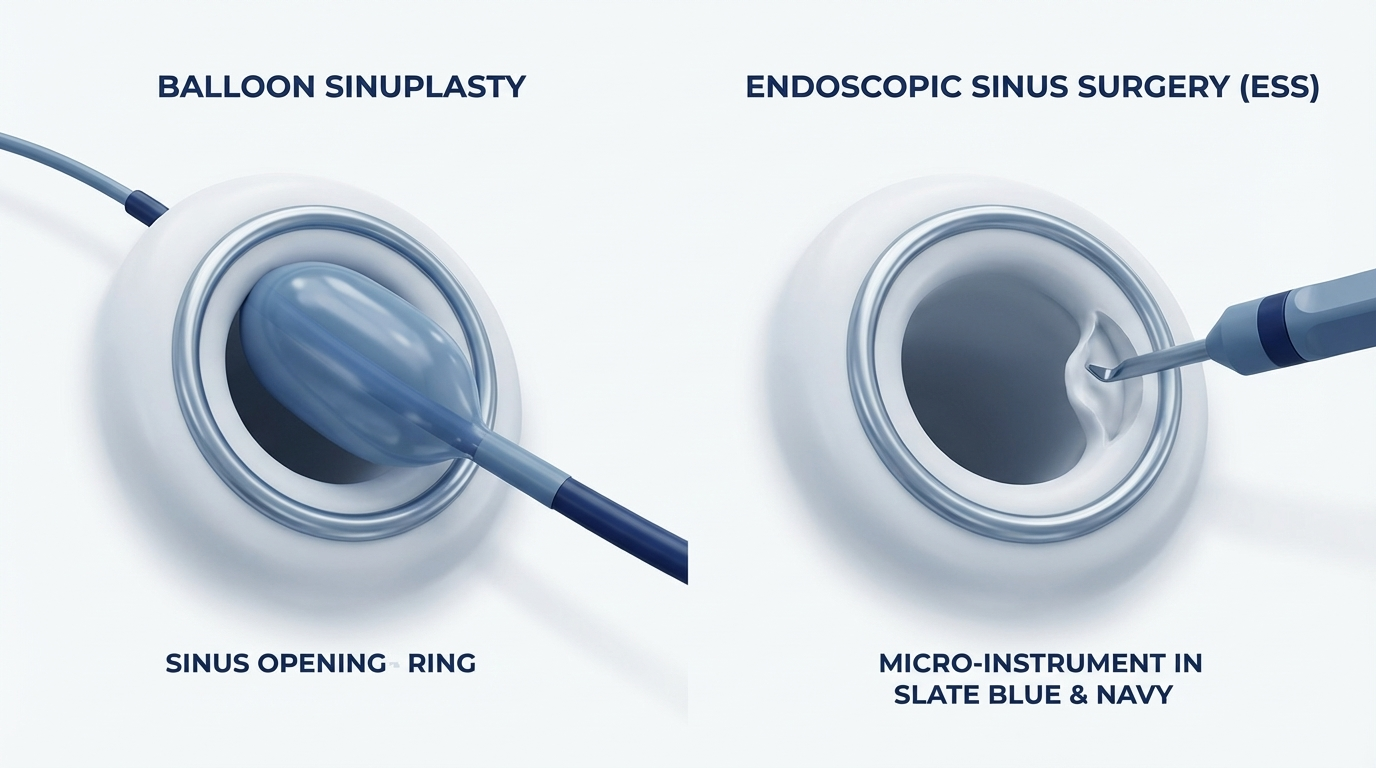
Often called endoscopic sinus surgery Atlanta patients commonly research, ESS uses a small camera to open blocked sinus drainage pathways and improve ventilation. Many ENTs describe it like “opening and reshaping the natural doorways” so mucus can drain and topical medications can reach the inflamed lining more effectively. Learn more here: Endoscopic sinus surgery (what patients should know) https://sleepandsinuscenters.com/blog/endoscopic-sinus-surgery-what-patients-should-know
Balloon sinuplasty
Balloon dilation can be appropriate for selected anatomy and diagnoses—typically when the goal is to widen certain drainage pathways with minimal tissue removal. It’s not automatically “better” or “worse” than ESS; it’s more about whether it matches the pattern of disease seen on endoscopy and CT. More detail: Balloon sinuplasty https://sleepandsinuscenters.com/balloon-sinuplasty
Septoplasty / turbinate reduction
If nasal obstruction is a major issue, ENTs sometimes address the septum and/or turbinates at the same time as sinus treatment. For many patients, improving airflow can also make daily rinses and sprays more tolerable.
Revision sinus surgery
Revision work often requires more detailed planning and discussion of goals (symptom relief, fewer infections, improved medication delivery, etc.). This is one reason it’s important to match complexity with surgeon experience.
Rhinology / skull-base expertise (for select cases)
Most sinus surgeries are not skull-base surgery. But the sinuses sit near the eyes and brain, so advanced training and careful planning can matter more in complex anatomy, extensive polyps, or revision scenarios.
Choose the least invasive option that reliably treats your specific pattern of disease and supports long-term control.
Top ENT Sinus Surgeons in Atlanta (Highly Rated Specialists to Consider)
This section is meant to help you understand who may be a fit and why, rather than declaring a single “winner” for everyone seeking the best ENT in Atlanta for sinus surgery.
Academic rhinology & complex/revision care — examples of leaders
Public academic profiles in Atlanta highlight ENT surgeons with significant rhinology and revision experience. For example, John M. DelGaudio, MD is listed in the Emory University School of Medicine directory with leadership roles and an academic focus in rhinology/sinus and skull-base surgery. That type of background often aligns with managing complex anatomy and revision cases.
Source: Emory University School of Medicine directory profile (John M. DelGaudio, MD): https://med.emory.edu/directory/profile/?u=JDELGAU
Additional public provider profile: https://providers.emoryhealthcare.org/provider/john-m-del-gaudio/779786
Best fit may include: complex inflammatory disease, extensive polyps, and revision sinus surgery planning where advanced rhinology experience is especially relevant.
Other highly rated Atlanta endoscopic sinus surgeons (often appropriate for routine ESS)
National directories can be a starting point for identifying physicians recognized for endoscopic sinus surgery in the Atlanta area. U.S. News’ listing for endoscopic sinus surgery in Atlanta includes names such as John DelGaudio, MD; Ramie A. Tritt, MD; Emily M. Barrow, MD; and Sarah K. Wise, MD.
Source: U.S. News (Endoscopic Sinus Surgery, Atlanta): https://health.usnews.com/doctors/endoscopic-sinus-surgery/atlanta-ga
If you’re evaluating community-based options, public practice profiles can also help you confirm basics like clinical focus and hospital privileges. For example, an Atlanta ENT practice profile for Ramie A. Tritt, MD describes a focus on nasal and sinus surgery.
Source: https://www.atlantaent.com/provider/ramie-a-tritt-md
What “highly rated” can mean (and what it doesn’t)
- whether a surgeon is the best match for your specific diagnosis,
- what your long-term inflammation management plan will be,
- or how easy it will be to get timely follow-up care.
Use directories to build a shortlist, then use a consult to confirm fit. As one patient put it, “The turning point wasn’t the name—I finally understood why my sinuses weren’t draining and what we were going to do about it.”
Use public profiles and directories to build a shortlist, then let an in-person consult confirm best fit.
How to Choose the Best ENT for Your Sinus Surgery (Checklist)

Training & focus
Consider asking about:
- A dedicated sinus/rhinology focus (especially for complex cases)
- Experience with revision sinus surgery (if you’ve had surgery before)
- How often they perform the procedure being recommended
If your case sounds complicated, it’s reasonable to ask, “Is this the kind of case you see every week, or occasionally?” The goal isn’t to interrogate—it’s to match your needs with experience.
Hospital resources & technology
Depending on your case, you may want to ask about:
- CT-guided planning and/or image guidance availability
- Access to multidisciplinary care (allergy, pulmonology, etc.) if your situation warrants it
Many ENTs think of the CT like a road map: it shows which “routes” are blocked and where careful navigation matters most.
Practical considerations that matter
- Insurance network status
- Scheduling timelines
- Location and post-op follow-up plan (sinus surgery often involves more than one visit after the procedure)
- Reading patient reviews critically (look for patterns about communication, follow-up, and expectations—not just star ratings)
Questions to ask at your consult
- What did you see on my nasal endoscopy or CT that explains my symptoms?
- What procedure are you recommending and why?
- How many surgeries like mine do you do each year?
- What is the plan if symptoms return?
You can also ask a clarifying question that often improves decision-making: “What would you recommend if I were your family member—with the same CT and symptoms?”
A brief, focused consult with clear imaging review often reveals the best match more than any online rating.
What to Expect at a Sinus Surgery Evaluation

Typical workup
- Symptom history and review of prior medications tried
- In-office nasal endoscopy (a detailed look inside the nose)
- CT scan of the sinuses to map anatomy and guide planning
If you’ve had previous imaging, bring it. Comparing older and newer scans can help determine whether the problem is stable inflammation, an anatomic pinch point, or disease progression.
Matching symptoms to the right diagnosis
Not every headache or facial pressure issue is caused by sinuses. A careful workup helps avoid “everything is sinus” thinking and steers you toward the most appropriate next step—whether that’s medical therapy, a procedure, or considering non-sinus causes.
A careful, image-guided diagnosis prevents unnecessary procedures and targets the real problem.
Sinus Surgery Recovery, Risks, and Results (Patient-Friendly)
Common recovery timeline (general)
Recovery varies by procedure and by person. Many patients notice congestion and crusting early on, with gradual improvement over the following weeks. Return-to-work timing depends on the extent of surgery and job demands.
A helpful expectation-setter: in the early phase, you may feel “stuffy but healing,” and improvement tends to come in steps rather than overnight.
Post-op care basics
Post-procedure care often includes:
- Saline irrigation (to reduce crusting and support healing)
- Follow-up visits (some patients need in-office cleaning/debridement)
These follow-ups are often where the long-term plan becomes clearer—especially for inflammation-driven disease. Think of surgery as the “reset” and aftercare as the “maintenance.”
Risks to understand (clear, non-alarming)
Commonly discussed risks include bleeding, infection, scarring, and persistent symptoms that may require further treatment. Any surgery carries risks, and the specifics should be reviewed with your surgeon based on your anatomy and the planned procedure.
What “success” looks like
Success is usually measured by improved nasal breathing, fewer infections, better sense of smell, and improved quality of life. For inflammation-driven disease (especially polyps), ongoing medical management may still be important even after surgery.
Expect steady improvement with good aftercare, and partner on an inflammation-management plan for durable results.
Lifestyle Tips to Support Sinus Health (Before & After Treatment)
Home environment steps
- Keep indoor humidity in a comfortable range to reduce dryness and mold risk
- Address water leaks promptly
- Consider HEPA filtration if dust or allergens are triggers
Allergy-smart habits (Atlanta seasonality awareness)
Pollen can be intense seasonally. Tracking local counts and keeping windows closed during high pollen days may help some people reduce exposure.
Daily sinus-friendly routines
- Use saline rinses safely and consistently (per product instructions)
- Follow prescribed medication routines when recommended by your clinician
Small daily habits can amplify the benefits of medical therapy and surgery.
FAQs — Best ENT in Atlanta for Sinus Surgery
Is balloon sinuplasty the same as sinus surgery?
It’s a type of sinus procedure, but it isn’t the same as full endoscopic sinus surgery. Balloon dilation may be used for specific sinuses and selected diagnoses, while ESS typically involves opening pathways more directly using endoscopic instruments.
Should I go to an academic center for sinus surgery?
An academic setting can be helpful for complex or revision cases, but many routine cases are treated successfully in community settings as well. The “best” choice depends on the complexity of your disease, your surgeon’s experience, and follow-up access.
How do I know if I need revision sinus surgery?
Revision surgery is usually considered when symptoms persist and testing (endoscopy/CT) shows ongoing obstruction, scarring, recurrent polyps, or untreated areas. The decision should be based on objective findings—not symptoms alone.
Does a U.S. News listing mean a doctor is right for me?
Not necessarily. Listings can help identify experienced names, but you still want a consult to confirm diagnosis, options, communication style, and the plan for long-term control of inflammation. Source: U.S. News Atlanta listing: https://health.usnews.com/doctors/endoscopic-sinus-surgery/atlanta-ga
Can insurance limit which ENT I can choose?
Yes. Insurance networks may narrow options, so it’s smart to verify coverage early—especially since sinus care often includes imaging, follow-ups, and prescriptions.
What if my symptoms are “sinus-like” but my CT is normal?
That can happen. A normal CT may suggest looking beyond sinus disease (for example, certain headache types, reflux, or other nasal conditions). An ENT evaluation helps clarify the most likely cause.
Conclusion — Making a Confident Choice in Atlanta
Finding the best ENT in Atlanta for sinus surgery comes down to one key principle: match the surgeon’s experience and resources to your case complexity. If you likely need a straightforward procedure, many qualified Atlanta ENTs may be appropriate. If you’ve had prior surgery or have complex inflammatory disease, it may be worth prioritizing a surgeon with deeper revision and rhinology experience.
If you’re ready to clarify your diagnosis and options, you can book an appointment for an evaluation with Sleep and Sinus Centers of Georgia here: https://sleepandsinuscenters.com/appointments
You can also start at the main site for additional resources: https://www.sleepandsinuscenters.com/
The “best” choice is the one that fits your diagnosis, complexity, and comfort with the plan.
Sources
- Emory University School of Medicine directory — John M. DelGaudio, MD: https://med.emory.edu/directory/profile/?u=JDELGAU
- Emory Healthcare provider page — John M. DelGaudio, MD: https://providers.emoryhealthcare.org/provider/john-m-del-gaudio/779786
- U.S. News — Best Doctors for Endoscopic Sinus Surgery (Atlanta, GA): https://health.usnews.com/doctors/endoscopic-sinus-surgery/atlanta-ga
- Atlanta ENT — Ramie A. Tritt, MD: https://www.atlantaent.com/provider/ramie-a-tritt-md
This article is for educational purposes only and is not medical advice. Please consult a qualified healthcare provider for diagnosis and treatment.
Don’t let allergies slow you down. Schedule a comprehensive ENT and allergy evaluation at Sleep and Sinus Centers of Georgia. We’re here to find your triggers and guide you toward lasting relief.