Balloon Sinuplasty Risks: Side Effects, Complications, and Safety Concerns
If you’re considering sinus balloon dilation, it’s normal to wonder about balloon sinuplasty risks—what’s expected during healing, what’s uncommon, and what would be considered a true emergency. This guide is designed to be patient-friendly and practical, so you can have a more informed discussion with your ENT team.
A helpful way to think about risk is to separate “typical healing effects” (temporary congestion, mild bleeding) from true complications (unusual bleeding, infection, rare anatomy-related injuries). Many post-procedure symptoms fall into the first category—and knowing that ahead of time can make recovery feel much less stressful.
Quick Take: How Safe Is Balloon Sinuplasty?
The short version
Balloon sinuplasty (also called sinus balloon catheter dilation) is generally considered minimally invasive and is often well tolerated in appropriately selected patients. Many people experience temporary symptoms such as congestion, mild soreness, and light drainage.
Serious balloon sinuplasty complications—such as injury near the eye or a CSF leak after balloon sinuplasty—are uncommon, but they’re important to understand because early evaluation matters.
Some randomized trial data suggest balloon dilation may have fewer overall complications than traditional sinus surgery (FESS) in selected patients, while revision rates appear similar in those studies.[1]
Featured snippet: Common side effects vs. rare complications (and when to call)
Common balloon sinuplasty side effects (often temporary):
- Mild bleeding/bloody mucus
- Congestion and swelling
- Facial pressure or soreness
- Increased drainage during healing
- Fatigue for a day or two
Rare but serious complications (urgent evaluation):
- Clear, watery, one-sided drainage that seems unusual (possible CSF leak)
- Severe headache that’s escalating, neck stiffness, or feeling significantly unwell
- Severe eye pain, swelling around the eye, double vision, or vision changes
- Heavy bleeding that doesn’t slow
Learn more about the procedure itself here: balloon sinuplasty (https://sleepandsinuscenters.com/balloon-sinuplasty).
In short: balloon sinuplasty is commonly well tolerated, and recognizing a few red flags helps you respond quickly if something isn’t typical.

What Is Balloon Sinuplasty (Sinus Balloon Dilation)?
What the procedure does
During balloon sinuplasty, a small balloon catheter is guided into a narrowed sinus drainage pathway and gently inflated. The goal is to widen the natural opening so mucus can drain more effectively and pressure can improve—without removing large amounts of tissue.
Many clinicians explain it with an analogy: it’s similar in concept to “opening” a narrowed channel rather than cutting away lots of material. That tissue-sparing approach is part of why many patients ask specifically about balloon sinus dilation safety.
Who it’s typically for
Balloon sinus dilation is often used for people with chronic or recurrent sinus symptoms related to blocked sinus drainage pathways, especially when imaging and exam suggest a targeted area of narrowing rather than widespread inflammatory disease.
In practical terms, that often means your ENT is matching your symptoms to what they see on nasal exam and CT—so the procedure targets the specific sinus opening(s) most likely to be causing the bottleneck.
How it differs from “traditional” sinus surgery
Functional Endoscopic Sinus Surgery (FESS) typically involves surgical instruments used to remove tissue and open sinus pathways more extensively. Balloon dilation is often described as tissue-sparing, which is one reason many people focus on balloon sinus dilation safety and a potentially faster recovery.
It’s also why two people can have “sinus surgery” and have very different recovery experiences—because the amount of tissue work can differ significantly.
If you want a deeper dive into the technique itself, see balloon sinuplasty (https://sleepandsinuscenters.com/balloon-sinuplasty).
In short: balloon dilation aims to widen natural drainage pathways with minimal tissue removal, especially when imaging shows specific narrowings.

Balloon Sinuplasty vs FESS—Complication and Revision Risk (What Research Shows)
In a 2025 meta-analysis of randomized controlled trials (14 RCTs; 1,060 total participants), balloon sinus dilation (SBCD) was compared with FESS.[1] Here are key safety-related takeaways:
Overall complications
In the studied populations, balloon dilation was associated with fewer overall complications than FESS (odds ratio 0.14, 95% CI 0.08–0.26).[1] Put simply, in these trials, balloon dilation was linked to much lower odds of complications overall—while still being studied head-to-head against standard endoscopic surgery.
Adhesions/scabbing
The same analysis found balloon dilation was associated with fewer postoperative adhesions and scabbing than FESS.[1] That matters because adhesions (scar bands) and heavy scabbing can contribute to a more uncomfortable recovery and may sometimes require closer postoperative care.
Revision surgery
Revision rates were not statistically different between the two approaches in the meta-analysis (OR 0.51, 95% CI 0.12–2.21; P=.37).[1] In other words: balloon dilation may reduce certain near-term complications, but some patients in either group may still need additional treatment later depending on anatomy, inflammation, and underlying triggers.
Infection/bleeding
In that analysis, there were no significant differences in postoperative infection or bleeding rates between approaches.[1]
If you’d like a deeper comparison, see balloon sinuplasty vs traditional sinus surgery (https://sleepandsinuscenters.com/blog/balloon-sinuplasty-vs-traditional-sinus-surgery-wh-20260121035146).
In short: RCT data suggest balloon dilation can have fewer overall complications than FESS in selected patients, with similar revision rates over time.[1]
Common Balloon Sinuplasty Side Effects (Expected and Usually Mild)
Understanding what’s common can make recovery feel less stressful. These balloon sinuplasty side effects are frequently reported and are typically temporary (though exact timing varies by person and by which sinuses were treated).
One ENT-style way of framing it is: “You should expect your nose and sinuses to act like they’ve been irritated—even if the procedure is minimally invasive.” That expectation can help you distinguish normal healing from a true red flag.
Mild bleeding or bloody drainage
A small amount of blood-tinged mucus can happen early on. This is often what people mean when they describe balloon sinuplasty bleeding—usually light spotting rather than heavy bleeding.
A concrete example patients mention: light pink mucus when wiping or a small amount of blood-tinged drainage that gradually fades. If bleeding ramps up instead of tapering down, that’s when you contact your surgeon.
Nasal congestion/swelling
Swelling in the nasal passages can temporarily make breathing feel more difficult. Some people feel “stuffy” even though the sinus pathway has been opened.
This can feel counterintuitive—like “Shouldn’t I breathe better immediately?”—but early swelling is a common part of healing after almost any nasal procedure.
Pressure, soreness, or facial discomfort
Mild to moderate pressure or tenderness—often around the treated sinus area—can occur. Many people describe this as a “bruised” or “sinus pressure” feeling.
A practical comparison: it may feel like the heaviness you get with a cold, but localized to the treated area. The overall trend should be gradual improvement, not escalating pain.
Increased sinus drainage during healing
As drainage pathways open and the lining heals, mucus can temporarily increase. This can feel like a runny nose or postnasal drip for a short period.
Some patients notice they’re swallowing more or clearing their throat more often for a few days—annoying, but typically short-lived.
Fatigue / “just had a procedure” feeling
Even minimally invasive procedures can leave you feeling tired for a day or two—especially if you had sedation.
Many people describe it as a “low-energy day,” similar to the day after a poor night of sleep. Planning a lighter schedule can make recovery smoother.
In short: mild bleeding, stuffiness, pressure, and a short-lived dip in energy are all common parts of early healing.
Uncommon but Possible Complications (Still Important to Know)
“Uncommon” doesn’t mean “impossible.” These balloon sinuplasty risks are generally infrequent, but they’re worth recognizing so you can communicate clearly with your care team if symptoms worsen rather than improve.
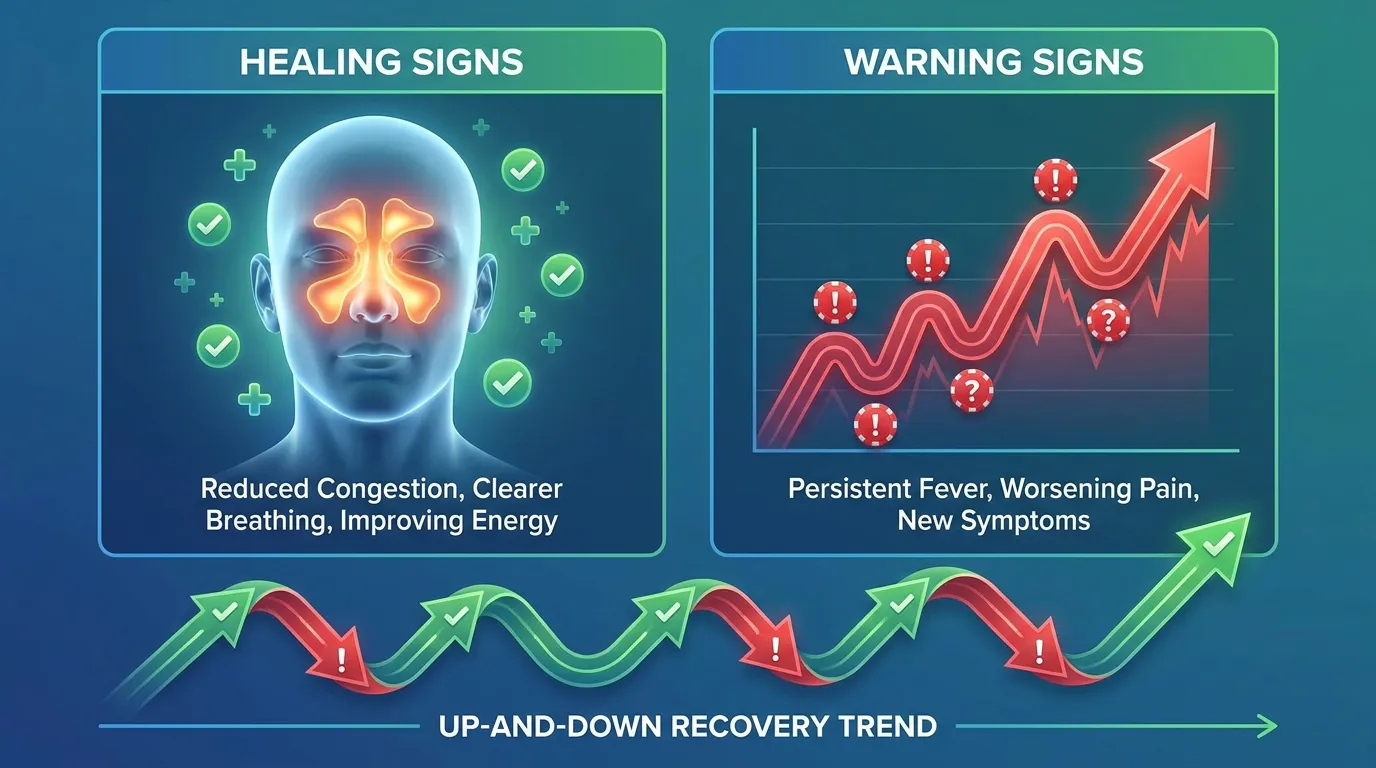
A useful rule of thumb: steady improvement is reassuring; a clear turn toward “worse day by day” deserves a call.
Infection
A balloon sinuplasty infection may present as worsening facial pain/pressure, thick discolored drainage with foul odor, or fever—especially if symptoms trend worse after initially improving. Evaluation may include an exam and, in some cases, testing of nasal drainage.
When patients say, “I felt like I turned a corner, then suddenly I got worse,” that pattern is often what prompts clinicians to consider infection or another treatable issue.
Significant bleeding
More noticeable bleeding is uncommon, but it can occur. This is one reason medication review matters—particularly blood thinners and medications that affect clotting.
This is also why your team may give very specific instructions about aspirin/NSAIDs and other medications. If you’re unsure what applies to you, it’s worth clarifying before the procedure day.
Scarring, adhesions, or persistent blockage
Even with balloon dilation, healing tissue can scar or swell in a way that contributes to persistent symptoms. Follow-up visits help monitor healing and address issues early.
Think of it like any healing surface: the goal is to heal “open and smooth,” not “sticky and narrowed.” Your surgeon’s aftercare plan is designed to support that.
Procedure failure or incomplete relief
Not all sinus symptoms come from a simple narrowing of a sinus opening. Allergies, non-allergic rhinitis, migraine-type facial pain, or ongoing inflammation can mimic “sinus” problems. In those cases, opening a drainage pathway may not fully resolve symptoms.
This is also why a careful diagnostic workup matters—so you’re treating the true driver of symptoms, not just the most obvious one.
In short: uncommon complications are typically manageable when recognized early and discussed promptly with your care team.
Rare but Serious Balloon Sinuplasty Complications (Medical Emergencies)
These are unusual, but they’re the reason many people search for balloon sinuplasty risks in the first place: they’re high-impact events where early evaluation is important.
A clinician might put it this way: “Rare doesn’t mean never—so we want you to recognize the warning signs and call promptly.”
Cerebrospinal fluid (CSF) leak
A CSF leak after balloon sinuplasty refers to leakage of cerebrospinal fluid, which normally surrounds the brain and spinal cord, potentially occurring if there is an injury near the skull base (rare). People often describe:
- Clear, watery drainage (often one-sided) that seems different from typical mucus
- Severe or escalating headache
- Neck stiffness or significant sensitivity to light (in some cases)
Because clear drainage can also occur with allergies, the pattern matters—especially if it’s unusually watery, one-sided, persistent, and paired with other concerning symptoms.
Orbital (eye area) injury / vision risk
The sinuses sit close to the orbit (eye socket). Rare injury near the eye can be serious. Warning signs can include:
- Severe eye pain or swelling around the eye
- Double vision
- Vision changes
Eye symptoms after a sinus procedure warrant prompt medical evaluation.
Device-related mechanical problems
Mechanical issues (such as balloon rupture) are recognized but uncommon. Even when mechanical issues occur, your surgeon’s training and the procedural setting are designed to identify and manage problems quickly.
When to seek urgent evaluation
Educationally speaking, urgent evaluation is typically warranted for:
- Heavy bleeding that doesn’t slow
- Severe headache that is rapidly worsening or feels unusual
- Eye pain, significant swelling around the eye, double vision, or vision changes
- Clear, watery drainage that raises concern for a CSF leak
- High fever or feeling severely ill
In short: true emergencies are rare; knowing the warning signs helps ensure fast, appropriate care.
Who Is at Higher Risk? (Patient Selection and Anatomy Matter)
A big part of balloon sinus dilation safety is choosing the right procedure for the right diagnosis.
In many practices, the “safest” procedure is the one that best matches what’s happening in your nose and sinuses—based on symptoms, endoscopy, and CT findings.
Patients who may not be ideal candidates
Some people need a different approach—especially if they have extensive polyps, more severe chronic sinus disease, or anatomy that requires more comprehensive surgical work. In those situations, FESS may be discussed instead.
If you’re still confirming whether ongoing symptoms are from sinus disease, this overview of chronic sinusitis (https://sleepandsinuscenters.com/chronic-sinusitis) can help you understand common patterns.
Why “good candidate” screening reduces risk
Pre-procedure evaluation often includes symptom review, nasal endoscopy, and CT imaging. This helps clarify which sinuses are involved and whether balloon dilation is likely to help.
That screening is also how your surgeon assesses nearby structures and identifies situations where a different technique may be safer or more effective.
Other factors that can increase risk
General health and medication factors can influence risk, such as:
- Bleeding or clotting disorders
- Uncontrolled high blood pressure
- Smoking/vaping
- Medications that affect bleeding (including some blood thinners)
- Uncontrolled diabetes or immune compromise
In short: matching the right patient to the right procedure meaningfully reduces risk.

How to Reduce Balloon Sinuplasty Risks (Before, During, and After)
Choose an experienced ENT team
Experience and careful patient selection can reduce the likelihood of uncommon complications and improve the chance of meaningful symptom relief.
If you’re deciding where to have the procedure, it’s reasonable to ask how often the clinician performs balloon dilation and how they decide between balloon dilation and FESS.
Pre-procedure checklist to discuss
Consider asking about:
- Which sinuses are being treated and why
- Medication guidance (especially blood thinners, aspirin, and NSAIDs)
- CT findings and anatomic considerations
- What symptoms are expected in the first few days
You can also ask: “What would make you want to hear from me after the procedure?” Getting those thresholds upfront can reduce anxiety later.
Follow aftercare instructions carefully
Post-procedure instructions commonly focus on gentle nasal care, activity limitations, and follow-up. These steps support healing and reduce preventable issues.
For example, if your surgeon recommends saline care, it’s usually because keeping the nose comfortably moist and clear can support smoother healing and reduce crusting.
Don’t ignore new or escalating symptoms
A key safety point: worsening symptoms after initial improvement should be communicated to your clinician.
If you’re debating whether something “counts,” it’s generally better to call and be reassured than to wait and wonder.
In short: preparation, clear expectations, and careful aftercare go a long way toward minimizing risk.
Recovery and Aftercare (What to Do and What to Avoid)
Typical recovery timeline (high level)
Many people return to normal routines sooner than after FESS, but there can still be a short period of congestion, drainage, and mild discomfort.
Some patients describe it as “I felt functional quickly, but my nose didn’t feel normal right away.” Both things can be true during healing.
For a more detailed expectations guide, see balloon sinuplasty recovery timeline (https://sleepandsinuscenters.com/blog/balloon-sinuplasty-recovery-timeline-day-by-day-he-20260120224024).
Helpful at-home care
Common comfort measures include rest, hydration, humidification, and head elevation. Many patients are also instructed to use saline in some form, depending on their surgeon’s protocol.
A simple, practical setup is sleeping with the head slightly elevated and keeping fluids nearby—small steps that can reduce pressure and dryness.
What to avoid early on
Your surgeon’s instructions come first, but early restrictions often involve avoiding heavy lifting, strenuous exercise, and nose blowing for a period of time.
These restrictions are typically about lowering the chance of bleeding and avoiding pressure changes while tissues are still settling.
Follow-up appointments
Follow-ups help monitor swelling, healing, and any debris/crusting that could contribute to recurrent blockage.
They’re also a good time to ask: “Is what I’m feeling on track for where I am in healing?”
In short: plan for a brief period of stuffiness and drainage, follow instructions closely, and use follow-ups to keep healing on track.

Symptoms After Balloon Sinuplasty—What’s Normal vs Not Normal
Normal (common) symptoms
- Mild bleeding/bloody mucus
- Congestion and swelling
- Drainage/postnasal drip
- Facial pressure or soreness
- Mild fatigue
Concerning symptoms (call your surgeon)
- Pain/pressure that’s increasing rather than improving
- Thick, foul-smelling drainage
- Fever or feeling progressively more ill
Emergency red flags (urgent care/ER)
- Heavy bleeding
- Severe eye pain, swelling, double vision, or vision changes
- Severe or escalating headache, neck stiffness, or unusual clear drainage (possible CSF leak)
In short: steady improvement is reassuring—new or worsening symptoms should prompt a call, and emergency red flags warrant urgent care.

Alternatives and Treatment Options If Balloon Sinuplasty Isn’t Right
Medical management
Depending on the cause, treatment may include saline irrigation, nasal steroid sprays, and allergy management. Antibiotics are typically reserved for situations where bacterial infection is suspected.
For many people, optimizing medical therapy—especially when allergies or chronic rhinitis are part of the picture—can reduce flare-ups even if a procedure is still on the table later.
Functional Endoscopic Sinus Surgery (FESS)
FESS may be recommended when disease is more extensive (for example, significant polyps or complex anatomy). If you’re comparing options, it’s reasonable to ask specifically about balloon sinuplasty vs FESS complications in the context of your CT findings and exam. For a side-by-side overview, see balloon sinuplasty vs traditional sinus surgery (https://sleepandsinuscenters.com/blog/balloon-sinuplasty-vs-traditional-sinus-surgery-wh-20260121035146).
Address related contributors
Deviated septum, turbinate enlargement, allergies, and chronic rhinitis can all affect nasal airflow and sinus symptoms—and sometimes need their own targeted plan.
This “whole-nose” approach can matter because better airflow and better drainage often go hand in hand.
In short: if balloon dilation isn’t the best fit, tailored medical therapy or FESS may provide better results depending on your specific disease pattern.
Lifestyle Tips to Support Sinus Health After the Procedure
- Reduce irritants (smoke, strong fragrances, dusty environments when possible)
- Optimize allergy control if allergies are a trigger
- Maintain hydration and consider humidification in dry indoor air
- Re-evaluate persistent symptoms—recurrence doesn’t always mean “sinuses are blocked again”; sometimes a different diagnosis is involved
For more on underlying sinus patterns and triggers, see chronic sinusitis (https://sleepandsinuscenters.com/chronic-sinusitis).
In short: small daily habits—hydration, humidification, and allergen control—can help protect your results.
FAQs
Is balloon sinuplasty safer than traditional sinus surgery?
Some randomized trial data suggest balloon dilation may have fewer overall complications than FESS in selected patients,[1] but both procedures carry risks, and the “safest” option depends on the individual patient and disease pattern.
What are the most common side effects?
Common balloon sinuplasty side effects include mild bleeding, congestion, facial soreness/pressure, increased drainage during healing, and short-term fatigue.
How long do side effects last?
Many symptoms improve within days, though congestion and drainage can take longer for some people. Recovery varies based on anatomy, the sinuses treated, and individual healing patterns.
What are signs of infection after balloon sinuplasty?
Possible signs include worsening facial pain, thick foul-smelling drainage, and fever—especially if symptoms are intensifying rather than improving.
Can balloon sinuplasty cause a CSF leak?
A CSF leak is an uncommon but recognized complication. Unusual clear watery drainage (often one-sided) or severe headache symptoms should be evaluated urgently.
What if balloon sinuplasty doesn’t work (or symptoms come back)?
Sometimes persistent symptoms reflect ongoing inflammation or another condition. Additional evaluation may lead to optimized medical therapy or discussion of other procedures; revision rates have not shown a clear difference between balloon dilation and FESS in randomized trial analysis.[1]
When should I call my doctor right away?
Educationally, urgent contact/evaluation is commonly recommended for heavy bleeding, fever with worsening symptoms, severe headache, eye pain/swelling, double vision/vision changes, or clear watery drainage concerning for a CSF leak.
Conclusion: Balancing Benefits, Risks, and the Right Candidate Fit
For many appropriately selected patients, balloon dilation has a favorable safety profile and a recovery that people often find manageable. Still, understanding balloon sinuplasty risks—from expected short-term symptoms to rare emergencies—helps you make a more confident decision and recognize when something isn’t normal.
If you’d like to discuss whether balloon sinus dilation fits your symptoms, imaging, and goals, book an appointment with Sleep and Sinus Centers of Georgia: https://www.sleepandsinuscenters.com/.
In short: informed expectations, good candidate selection, and attentive aftercare are the keys to a safer, smoother outcome.
References
[1] Liang X, et al. Efficacy and safety of sinus balloon catheter dilation versus functional endoscopic sinus surgery: meta-analysis (2025). https://pmc.ncbi.nlm.nih.gov/articles/PMC12173261/
This article is for educational purposes only and is not medical advice. Please consult a qualified healthcare provider for diagnosis and treatment.
Don’t let allergies slow you down. Schedule a comprehensive ENT and allergy evaluation at Sleep and Sinus Centers of Georgia. We’re here to find your triggers and guide you toward lasting relief.