Revision Septoplasty: Fixing Persistent Nasal Obstruction After a Failed First Surgery
Introduction — When Septoplasty Doesn’t Fix Your Breathing
Going through septoplasty and still feeling blocked can be discouraging. Persistent nasal obstruction after septoplasty can feel confusing—and exhausting, especially at night or during exercise.
Ongoing obstruction doesn’t automatically mean the first surgery was bad or that you did anything wrong. Sometimes the original cause (for example, nasal valve collapse) wasn’t fully identified, or a harder-to-correct area shifted again during healing. In other cases, inflammation, turbinate enlargement, or scar tissue becomes the bigger issue.
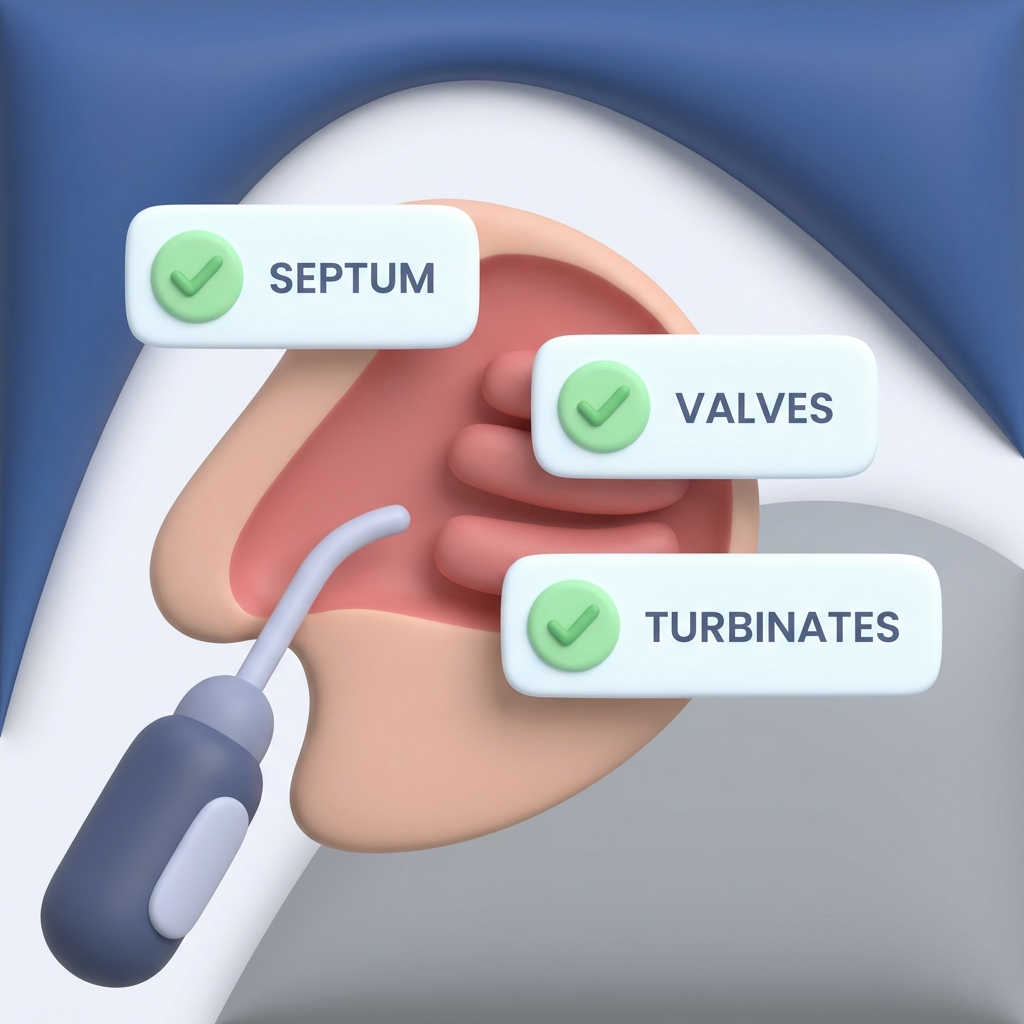
A simple mental model: your nasal airway is like a multi-lane tunnel. Straightening the septum can help, but if the entrance (nasal valve) is narrow, or the side panels (turbinates) stay swollen, you can still feel obstructed.
This guide covers symptoms and causes, what a thorough revision evaluation looks like, non-surgical steps, what revision surgery can address, recovery, and FAQs—so you can have a more informed conversation with an ENT.
Takeaway: It’s common to need a tailored plan after a first septoplasty because multiple structures—not just the septum—influence airflow.

What Is Revision Septoplasty?
Definition in plain language
Revision septoplasty is a second operation to improve nasal airflow when a first septoplasty did not adequately relieve obstruction. Septoplasty straightens the septum (the wall dividing the nasal passages) to improve breathing rather than appearance. Cleveland Clinic: https://my.clevelandclinic.org/health/treatments/17779-septoplasty
How revision surgery differs from a first-time septoplasty
- Less remaining septal cartilage available for support
- More scar tissue, making tissues less flexible and harder to reposition
- Greater chance of needing added structural support (grafts) to stabilize airflow
- Potentially more technical challenges and a longer recovery
One way ENTs frame it: “We’re not just straightening; we’re rebuilding support where the airway is collapsing.” Research shows many patients still experience meaningful improvement when true causes are identified and treated. Scientific Reports: https://www.nature.com/articles/s41598-022-23772-y; PMC review: https://pmc.ncbi.nlm.nih.gov/articles/PMC9883659/
Takeaway: Revision septoplasty focuses on stabilizing and supporting the airway, not just straightening the septum.
Symptoms — Signs You Might Need a Revision Septoplasty
Breathing and airflow symptoms
- Ongoing congestion on one or both sides
- Difficulty breathing during exercise or sleep
- Mouth breathing, dry mouth, waking up feeling stuffy
- A sense that airflow is limited even when mucus isn’t the issue
“Structural” clues that suggest a persistent blockage
- One nostril collapses inward when you inhale (possible nasal valve collapse)
- Breathing improves when you gently pull the cheek outward (Cottle-type maneuver)
- Worse with deeper breaths, at night, or when lying on one side
If external nasal strips or internal dilators help, it can suggest the airway needs better support.
Quality-of-life impact to mention to your ENT
- Sleep disruption and daytime fatigue
- Reduced activity tolerance
- Reliance on sprays or medications to get through the day
Many practices use the NOSE scale to measure severity and improvement. PMC: https://pmc.ncbi.nlm.nih.gov/articles/PMC9883659/
Takeaway: Note patterns and daily-life impacts—these details help your ENT connect symptoms to anatomy.
Why Septoplasty Sometimes “Fails” — Common Causes of Persistent Nasal Obstruction
Persistent or recurrent septal deviation (especially hard-to-fix areas)
- Caudal septal deviation (front/bottom) affects airflow and structural support.
- Dorsal septum deviation (top/bridge) can overlap with internal nasal valve support.
Background on deviation and symptoms: https://sleepandsinuscenters.com/deviated-septum-relief
Incomplete correction at the bony–cartilaginous junction
The junction between bone and cartilage can drift if not fully corrected or re-stabilized. PubMed: https://pubmed.ncbi.nlm.nih.gov/18702913/; Wiley: https://onlinelibrary.wiley.com/doi/10.1002/lary.24356
Nasal valve issues missed the first time (very common)
The internal nasal valve is the narrowest segment; weakness at the nostril rim can cause external valve collapse. If valve narrowing/collapse wasn’t recognized, obstruction can persist despite a straighter septum. PMC: https://pmc.ncbi.nlm.nih.gov/articles/PMC9883659; Scientific Reports: https://www.nature.com/articles/s41598-022-23772-y
More on valve repair: https://sleepandsinuscenters.com/blog/how-ent-doctors-fix-nasal-valve-collapse
Turbinate hypertrophy or chronic inflammation not addressed
Enlarged turbinates and rhinitis-related swelling can mimic or stack on septal issues, causing fluctuating symptoms.
Related: Turbinate reduction: https://sleepandsinuscenters.com/blog/everything-you-need-to-know-about-turbinate-reduction; Treating chronic rhinitis: https://sleepandsinuscenters.com/treating-chronic-rhinitis
Scar tissue, adhesions, or iatrogenic issues
- Synechiae (adhesions) that partially block airflow
- Changes in support that alter airflow dynamics
- Stiffness from scar tissue
Surgery performed in less specialized settings
Complex airflow problems often involve septum, turbinates, and valves together; if valve function or caudal support wasn’t fully evaluated, obstruction can persist.
Takeaway: Persistent blockage usually has a specific cause—often the nasal valves, a residual deviation, inflammation, or a combination.

Diagnosis — What to Expect During a Revision Septoplasty Evaluation
Your symptom story matters (what to track)
Track which side feels worse, triggers (exercise, sleep position, seasons, colds), and what helps (saline, steroid sprays, strips) vs what doesn’t. Real-life examples help connect symptoms to anatomy.
Nasal exam + endoscopy
Evaluation typically includes endoscopy to assess septal alignment/stability, turbinate size, scar tissue/adhesions, and signs of inflammation or polyps. Cleveland Clinic: https://my.clevelandclinic.org/health/treatments/17779-septoplasty
Nasal valve assessment (must-have)
Because valve collapse commonly drives persistent obstruction, clinicians observe breathing and perform functional maneuvers to gauge support. PMC: https://pmc.ncbi.nlm.nih.gov/articles/PMC9883659
When imaging (CT) may be considered
CT is considered if sinus disease is suspected, anatomy is unclear, or multiple contributors are likely—not everyone needs imaging.
Symptom scoring (NOSE scale)
The NOSE scale quantifies severity and tracks outcomes over time. Scientific Reports: https://www.nature.com/articles/s41598-022-23772-y; PMC: https://pmc.ncbi.nlm.nih.gov/articles/PMC9883659
Takeaway: A thorough exam plus targeted tests helps distinguish structural from inflammatory causes—and guides the right fix.
Treatment Options Before Revision Surgery (and When They Help)
Medication and non-surgical strategies
- Saline rinses
- Nasal steroid sprays (with proper technique)
- Allergy evaluation and treatment when appropriate
- Limited, careful use of decongestants (to avoid rebound)
These can reduce inflammation and clarify the structural component, even if surgery is ultimately needed.
Mechanical support options
External nasal strips or internal dilators can provide temporary relief and hint at valve narrowing.
When non-surgical care is unlikely to be enough
If residual deviation, caudal deviation, valve collapse, or a bony-cartilaginous junction issue is the main problem, medications alone rarely fully open the airway.
Takeaway: Try medical therapy for swelling, but structural blockages usually need structural solutions.

Revision Septoplasty Procedure — How Surgeons “Fix What Was Missed”
Goals of revision surgery
- Restore a stable, straight septum where it matters most
- Correct nasal valve narrowing/collapse when present
- Reduce turbinate obstruction when needed
Common surgical techniques
- Targeted correction of residual deviation (often caudal and/or dorsal)
- More complete work at the bony-cartilaginous junction
- Releasing scar tissue/adhesions blocking airflow
Small, high-impact corrections near the valve can make a big difference.
Structural support and grafting (when needed)
Grafts may be used to stabilize the septum, reinforce weak areas contributing to valve collapse, and improve long-term reliability. PubMed: https://pubmed.ncbi.nlm.nih.gov/18702913/; Wiley: https://onlinelibrary.wiley.com/doi/10.1002/lary.24356
Combining revision with other procedures
Often paired with turbinate reduction, nasal valve repair, or functional rhinoplasty components when added support is needed for breathing.
Takeaway: Effective revision targets the exact bottlenecks—often the valve area—sometimes with added support.

Recovery — Timeline and What Patients Usually Feel
The first week
Congestion from swelling and crusting is common; pressure/fullness is more typical than sharp pain. Breathing may feel worse before it improves.
Weeks 2–6
Airflow often improves gradually as swelling decreases. Follow-ups (and cleaning when needed) help healing and comfort.
When you may notice the final result
Healing continues for weeks to months, and revision cases can take longer to declare the outcome. Cleveland Clinic: https://my.clevelandclinic.org/health/treatments/17779-septoplasty
Takeaway: Expect gradual gains—revision recovery can take longer, with improvements over weeks to months.
Risks and Complications (Honest but Reassuring)
General surgical risks
Bleeding, infection, and persistent symptoms are possible.
Revision-specific considerations
More scar tissue and complexity, greater likelihood of needing grafts/support, and rare risks like septal perforation. Cleveland Clinic: https://my.clevelandclinic.org/health/treatments/17779-septoplasty; PMC: https://pmc.ncbi.nlm.nih.gov/articles/PMC9883659/
The goal of a tailored plan is to minimize surprises and improve outcomes.
Takeaway: A personalized plan aims to minimize risks and improve the odds of meaningful breathing relief.
Results — What the Research Says About Outcomes and Satisfaction
Breathing improvement and quality-of-life gains
When true causes (valve problems, residual deviation, turbinate contribution) are addressed, studies show significant improvements in patient-reported breathing and quality of life. Scientific Reports: https://www.nature.com/articles/s41598-022-23772-y; PMC: https://pmc.ncbi.nlm.nih.gov/articles/PMC9883659/; Wiley: https://onlinelibrary.wiley.com/doi/10.1002/lary.24356
Patients often report practical wins: better sleep, less mouth breathing during exercise, more balanced airflow.
Reduced reliance on nasal medications
Many use fewer rescue sprays once structural issues are fixed, especially when inflammation wasn’t the main driver. PMC: https://pmc.ncbi.nlm.nih.gov/articles/PMC9883659/
Takeaway: When the real cause is treated, most patients report better airflow and daily function.
How to Reduce the Chance of Needing a Second Surgery (Patient + Provider Tips)
Choose a thorough pre-op evaluation
Ask: “Have you checked my nasal valves and turbinates?” A straight septum is only one part of a stable airway.
Optimize inflammation first
Treat allergic/non-allergic inflammation to clarify structural vs swelling-driven obstruction and set accurate expectations.
Use objective symptom tracking
Track a NOSE score or simple diary (day vs night, exercise tolerance, medication use). Scientific Reports: https://www.nature.com/articles/s41598-022-23772-y
Takeaway: Upfront valve assessment, inflammation control, and symptom tracking can reduce the need for revision.
FAQs About Revision Septoplasty
How long should I wait after my first septoplasty before considering revision? Many surgeons prefer allowing healing and swelling to settle unless there’s a clear complication; timing depends on symptoms, anatomy, and healing.
Could my problem be nasal valve collapse instead of my septum? Yes—this is common, especially if strips/dilators help or the sidewall collapses when inhaling. PMC: https://pmc.ncbi.nlm.nih.gov/articles/PMC9883659/
Is revision septoplasty more painful or risky? It can be more technically complex due to scar tissue and reduced cartilage, but pain varies widely. Careful evaluation and a tailored plan are key. PubMed: https://pubmed.ncbi.nlm.nih.gov/18702913/; Cleveland Clinic: https://my.clevelandclinic.org/health/treatments/17779-septoplasty
Can I have more than one septum surgery? It’s possible, but identifying why symptoms persist (residual deviation, valve collapse, turbinate hypertrophy, inflammation, scar tissue, or a combination) matters most. PMC: https://pmc.ncbi.nlm.nih.gov/articles/PMC9883659/
Will revision septoplasty change how my nose looks? Often it doesn’t, but subtle changes can occur when caudal/dorsal support or valve repair is needed—discuss expectations upfront.
When to See an ENT (Call-to-Action Section)
- Persistent obstruction more than ~3 months after surgery (or worsening over time)
- Signs suggesting nasal valve collapse
- Daily dependence on sprays just to breathe comfortably
- Sleep disruption related to nasal blockage
Book an appointment: https://www.sleepandsinuscenters.com/ — or see any qualified ENT if you’re not local.
References
- Scientific Reports: https://www.nature.com/articles/s41598-022-23772-y
- PubMed: https://pubmed.ncbi.nlm.nih.gov/18702913/
- PMC: https://pmc.ncbi.nlm.nih.gov/articles/PMC9883659/
- Wiley Online Library: https://onlinelibrary.wiley.com/doi/10.1002/lary.24356
- Cleveland Clinic (Septoplasty): https://my.clevelandclinic.org/health/treatments/17779-septoplasty
Medical disclaimer
This article is for educational purposes only and is not medical advice. Please consult a qualified healthcare provider for diagnosis and treatment.
Don’t let allergies slow you down. Schedule a comprehensive ENT and allergy evaluation at Sleep and Sinus Centers of Georgia. We’re here to find your triggers and guide you toward lasting relief.