Magnesium and Melatonin: Benefits, Dosage, and Sleep Support
If you’ve ever stared at the ceiling unable to fall asleep, woken up repeatedly, or felt like your sleep schedule is “shifted” later than everyone else’s, you’re not alone. Many people look to supplements for help—especially magnesium and melatonin—but they don’t work the same way, and that’s where expectations can get mismatched.
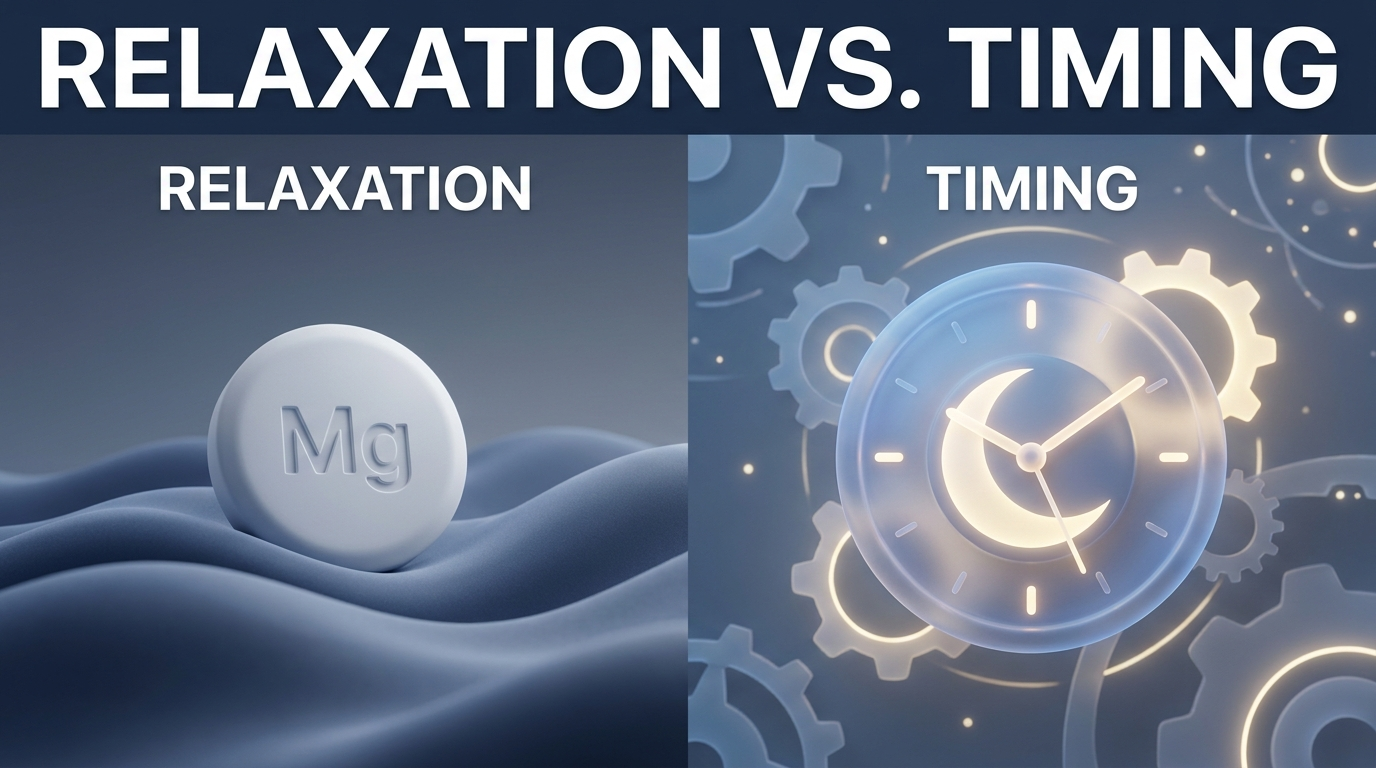
Key takeaway: magnesium may support melatonin synthesis and relaxation pathways in some people, while melatonin primarily acts as a circadian timing signal. Depending on what’s driving your sleep trouble, some people may benefit from one, or in some cases both, used thoughtfully.
Important note: This article is for education, not personal medical advice. Supplements can interact with medications and may not be appropriate for everyone. A clinician or pharmacist can help you review safety, dosing, and timing for your situation.
Magnesium vs. Melatonin—What’s the Difference?
What magnesium does in the body (sleep-relevant roles)
Magnesium is an essential mineral involved in hundreds of processes, including those related to sleep and relaxation. Sleep-relevant roles include:
- Supporting nervous system regulation and muscle relaxation
- Helping manage the body’s stress response
- Modulating brain signaling related to calm and arousal (for example, supporting GABA activity and moderating excitatory NMDA signaling)
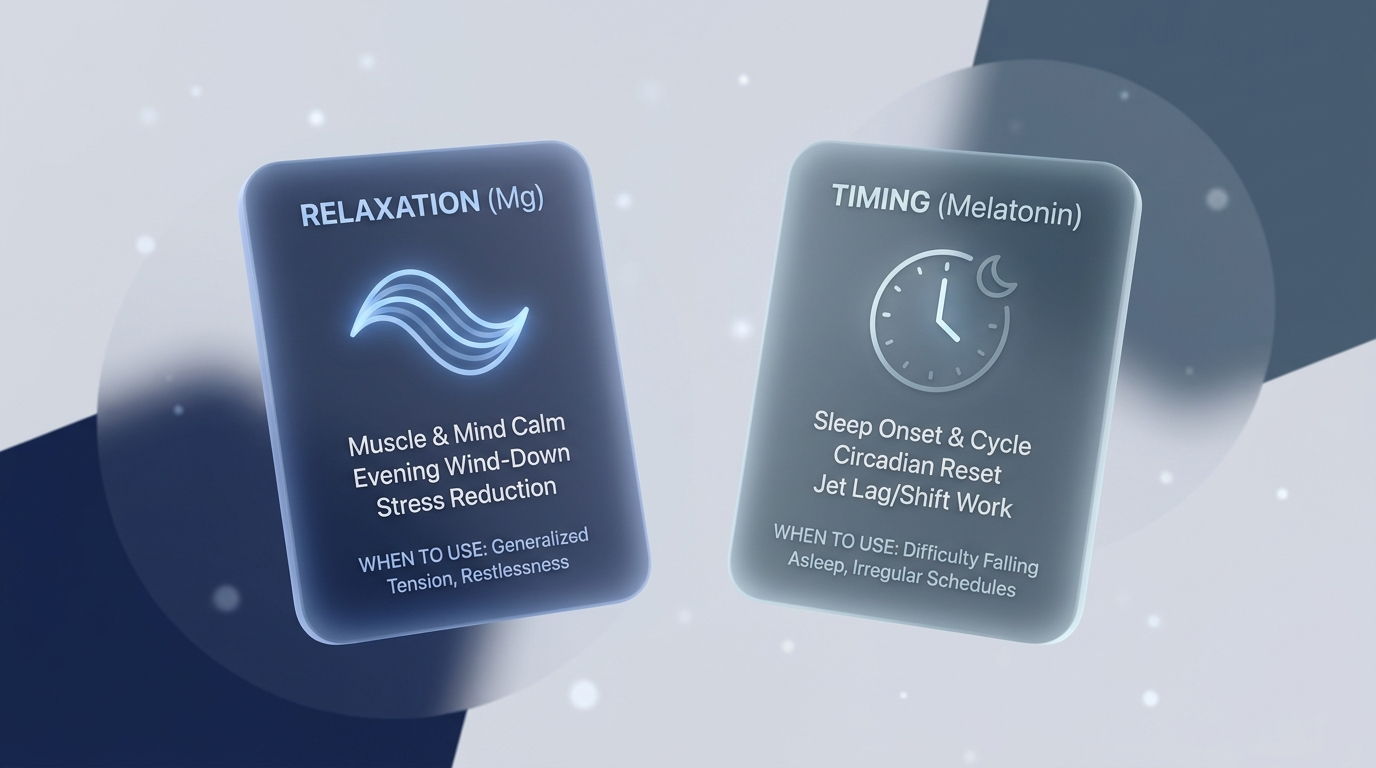
In plain language: magnesium isn’t a “knockout” supplement. It’s more like a support beam—helping the systems that make it easier to downshift at night, especially when stress, tension, or restlessness are part of the picture.
Concrete example (not a recommendation): if your mind is tired but your body feels tense (jaw clenching, tight shoulders, “wired but tired”), magnesium is often the supplement people consider first.
Bottom line: magnesium is about relaxation physiology, not sedation.

What melatonin does (and what it doesn’t)
Melatonin is a hormone your brain releases in response to darkness. Its main job is to help regulate your circadian rhythm—your internal “body clock.” That’s why supplemental melatonin is often most helpful for timing-related sleep issues such as:
- Delayed sleep phase (“I’m not sleepy until very late”)
- Jet lag
- Shift work schedule changes
Melatonin primarily acts as a circadian timing signal rather than a sedative. It isn’t always the best tool for “knocking you out,” and higher doses don’t always work better.
Bottom line: melatonin helps set the clock more than it deepens sleep.

Why people confuse them
Both appear in the sleep aisle, both are marketed for insomnia, and both can be taken at night—but they target different bottlenecks:
- Magnesium: relaxation and sleep physiology
- Melatonin: circadian timing and sleep scheduling
Matching the tool to the bottleneck improves the odds of noticing a benefit.
How Magnesium and Melatonin Connect Biologically (The “Intersection”)
Magnesium may support endogenous melatonin production
Mechanistic research suggests magnesium is involved in pathways that help the body make melatonin. For example:
- Magnesium deficiency in animal models has been associated with lower melatonin levels.
- Magnesium may support activity of arylalkylamine N-acetyltransferase (AANAT), also called serotonin N-acetyltransferase, a key enzyme in melatonin synthesis.
Animal studies have found associations, but human evidence is more limited.
A helpful analogy: melatonin is the “message” (night is here), and magnesium may help support some of the “machinery” that produces and regulates that message.
Human clinical evidence: magnesium was associated with higher melatonin in older adults
In a double-blind randomized trial of older adults with primary insomnia, magnesium supplementation was associated with increased serum melatonin and improvements in several sleep measures (Abbasi et al., 2012). The study used magnesium oxide 500 mg/day, which corresponds to roughly 300 mg/day of elemental magnesium.
This does not mean magnesium will help everyone, but it supports magnesium’s relevance to sleep biology in some people.
Complementary mechanisms suggest potential synergy
When people pair magnesium and melatonin, the logic is usually “relaxation + timing.” Mechanistically:
- Magnesium may support calming neurotransmission and stress physiology.
- Melatonin helps shift circadian timing and has antioxidant properties.
If you’re sleepy at the wrong time, melatonin can help with the clock. If you’re tired but too revved up, magnesium may help with the “brakes.” This doesn’t mean everyone needs both.
If both timing and arousal are issues, a combination approach may be reasonable—with clinical guidance.

Benefits for Sleep—What the Research Actually Shows
Magnesium for insomnia: modest, mixed, and context-dependent
Across small clinical trials—especially in older adults—magnesium supplementation has been associated with modest improvements in time to fall asleep, sleep efficiency, and subjective sleep quality. Effects vary, and benefits are more likely when tension, stress, or low intake are part of the picture.
Expectation-setting helps: magnesium’s benefits are usually modest rather than dramatic.
Melatonin: strongest for circadian misalignment
Melatonin tends to perform best when the problem is sleep timing, not necessarily sleep depth. Many people notice the biggest benefit when melatonin is used consistently and timed appropriately (often earlier than “lights out”).
Concrete example (not a recommendation): if you’re naturally getting sleepy at 1–2 a.m. but need to fall asleep by 10:30 p.m., melatonin may work better as a scheduled “shift” than as a last-second bedtime rescue.
In short: melatonin is most helpful when your internal clock runs late or must shift.
Combination products (melatonin + magnesium + zinc): what we know
In older adults with primary insomnia, a supplement containing melatonin, magnesium, and zinc improved sleep quality and increased total sleep time compared with placebo (Rondanelli et al., 2011). This does not prove each ingredient’s independent contribution, but it supports the idea that combination formulas may help when multiple sleep bottlenecks are present.
Combination products can help some people, but they don’t reveal which ingredient is doing what.
Signs You Might Consider Magnesium, Melatonin, or Both
Symptoms overlap and aren’t diagnostic, but these patterns can help guide a discussion with your clinician.
Common sleep symptoms people are trying to improve
- Trouble falling asleep
- Frequent awakenings or light, fragmented sleep
- Early morning waking
- Non-restorative sleep and daytime fatigue
Clues magnesium might be relevant (not definitive)
- Muscle cramps/twitches, stress-related tension, or a “wired but tired” feeling
- Low dietary intake or higher risk of deficiency
Clues melatonin might be relevant (circadian pattern)
- A consistent “second wind” at night and very late sleepiness
- Shift work or rotating schedules
- Jet lag after travel
A practical clue: if you’re alert late even on calm, low-stress days—and you sleep in easily when allowed—circadian timing may be the bigger issue.
Causes of Poor Sleep That Supplements Can’t Fully Fix (But Shouldn’t Be Missed)
Medical and sleep-disorder causes
Some sleep problems are less about supplements and more about identifying an underlying issue, such as:
- Obstructive sleep apnea
- Restless legs syndrome
- Chronic pain, reflux, anxiety/depression
- Medication side effects
Sleep-disordered breathing can also fragment sleep; for an ENT-relevant angle, see nasal breathing for better sleep: https://sleepandsinuscenters.com/blog/nasal-breathing-benefits-for-better-sleep-quality
If insomnia becomes persistent, evaluation can be more effective than “stacking” supplements.
Lifestyle/environment causes
- Late caffeine or alcohol
- Inconsistent sleep schedule
- Evening bright light/screen exposure (see blue light and sleep: https://sleepandsinuscenters.com/blog/blue-light-and-its-impact-on-ent-related-sleep-disorders-1bca5)
- Stress and “hyperarousal” at bedtime
Supplements often disappoint when the main driver is an untreated disorder or a schedule/light mismatch.
Dosage Guide (Practical, Cautious, Evidence-Informed)
Talk with your clinician or pharmacist first, especially if you’re pregnant, older, have kidney disease, or take prescription medications.
Magnesium dosage for sleep
One randomized controlled trial in older adults used magnesium oxide 500 mg/day for 8 weeks (approximately 300 mg elemental magnesium) and reported improved sleep measures (Abbasi et al., 2012). In everyday products:
- Some labels list the compound amount (e.g., magnesium glycinate) rather than elemental magnesium.
- Two products can look similar but deliver very different elemental doses.
A practical approach is to start low to assess stomach tolerance and adjust gradually, rather than starting at the highest dose on day one.
Magnesium form matters (tolerability and absorption)
- Magnesium glycinate: often chosen for better GI tolerability
- Magnesium citrate: can loosen stools (sometimes used for constipation)
- Magnesium oxide: more likely to cause GI side effects for some and is less absorbed than other forms
Melatonin dosage (why lower is often tried first)
For circadian timing, many clinicians suggest starting low and adjusting carefully, since higher doses may increase next-day grogginess or vivid dreams for some people. “More” is not automatically better.
Timing: when to take each
- Magnesium: often taken in the evening; consider taking with food if it upsets your stomach
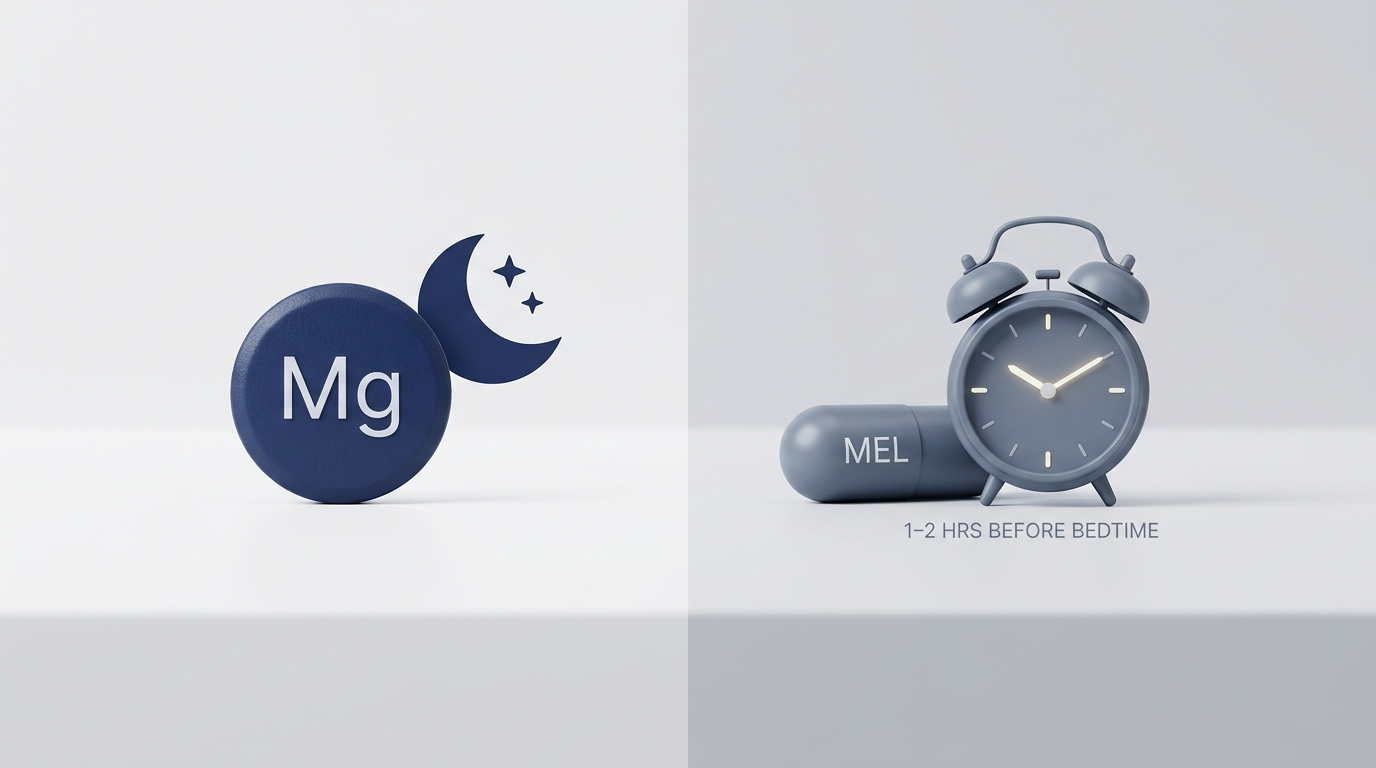
- Melatonin: commonly taken 1–2 hours before the desired bedtime as a circadian signal (not necessarily at lights out)
Can you take magnesium and melatonin together?
Combination formulas that include melatonin, magnesium, and zinc have improved sleep outcomes in older adults (Rondanelli et al., 2011). Practically, many people prefer changing one variable at a time so it’s clearer what is (or isn’t) helping.
Work with a clinician to match dose and timing to your goals and medications.
Safety, Side Effects, and Interactions (Must-Read)
Magnesium—common side effects and who should be cautious
- Most common: GI upset or diarrhea (often dose-related)
- Extra caution: kidney disease, where magnesium can accumulate
Melatonin—common side effects and cautions
- Morning grogginess, vivid dreams, headache
- Use caution with driving or safety-sensitive tasks if you feel drowsy
Medication interactions to ask about
- Magnesium can interfere with absorption of some medications (including certain antibiotics and thyroid medication). Take them at different times, typically separated by several hours.
- Melatonin may interact with sedatives and other drugs; a pharmacist can help screen for issues.
Special populations
- Pregnancy/breastfeeding: discuss with a clinician first
- Older adults: higher risk of medication interactions
- Teens/children: avoid self-prescribing; pediatric sleep problems deserve individualized evaluation
When in doubt, review your plan with a clinician or pharmacist before starting.
Treatment Plan Beyond Supplements (Best “Sleep Support” Results)
Sleep hygiene foundations (simple checklist)
Supplements tend to work best on top of good habits. A practical starting point is a sleep hygiene checklist from Sleep and Sinus Centers of Georgia: https://sleepandsinuscenters.com/blog/sleep-hygiene-and-its-impact-on-ent-disorders-key-insights
Food-first magnesium support (easy options)
Magnesium-rich foods include:
- Nuts and seeds (pumpkin seeds, almonds)
- Beans and lentils
- Leafy greens (spinach)
- Whole grains
One-day example: oatmeal with nuts (breakfast), lentil salad (lunch), salmon with spinach (dinner), and yogurt with seeds (snack).
Stress + cortisol support strategies (non-pill tools)
- Relaxation breathing (2–5 minutes)
- Progressive muscle relaxation
- A quick “brain dump” journal before bed
- Gentle stretching
Simple, repeatable wind-down routines directly target the pre-sleep arousal loop.
Magnesium vs Melatonin—What Research Is Still Needed
We have studies on magnesium and separate studies on melatonin, but few direct head-to-head comparisons for primary insomnia. That’s one reason advice can feel contradictory: the best choice often depends on whether your main problem is timing or hyperarousal (or both).
More high-quality, comparative trials would help match treatments to symptom patterns.
FAQs
1. Is magnesium or melatonin better for staying asleep?
Magnesium has some evidence for improving overall sleep quality and reducing awakenings in certain groups; melatonin is more timing-focused.
2. Is magnesium or melatonin better for falling asleep faster?
Magnesium shows modest improvements in time to fall asleep in small trials; melatonin can help when sleep onset is delayed due to circadian timing.
3. What if melatonin helps me fall asleep but I still wake up at 3 a.m.?
That pattern can be related to stress/arousal, environment, alcohol, reflux, or sleep disorders. It may be worth reviewing sleep habits and considering an evaluation.
4. Can I take magnesium every night long-term?
Many people do, but long-term use should consider dose, kidney function, GI tolerance, and medication timing.
5. Can melatonin stop working over time?
Some people report diminishing benefit, especially if the underlying driver is not circadian. Timing and dose may also affect results.
6. What’s the best magnesium type for sleep—glycinate, citrate, or oxide?
Glycinate is often chosen for tolerability; citrate may cause loose stools; oxide is more likely to cause GI side effects for some.
7. Can magnesium raise melatonin naturally?
Possibly. In an RCT of older adults with insomnia, magnesium supplementation was associated with increased serum melatonin (Abbasi et al., 2012).
8. Who should not take magnesium or melatonin?
People with kidney disease, those who are pregnant/breastfeeding, and anyone on multiple medications should discuss risks and interactions first.
9. When should I see a sleep specialist instead of trying supplements?
If symptoms suggest sleep apnea, severe daytime sleepiness, or long-lasting insomnia, evaluation is often the most efficient next step.
When to See a Doctor (Red Flags)
Consider scheduling an evaluation if you notice:
- Loud snoring with choking/gasping
- Excessive daytime sleepiness despite adequate time in bed
- Insomnia lasting more than 3 months
- New or worsening anxiety/depression symptoms
- Severe restless legs symptoms
- Concerns about medication interactions or kidney disease
For guidance on next steps, see when to see a sleep specialist: https://sleepandsinuscenters.com/blog/when-to-see-an-ent-for-sleep-problems
If you’re ready for a professional review of your symptoms (especially if snoring, mouth breathing, or suspected sleep apnea is in the mix), you can book an appointment with Sleep and Sinus Centers of Georgia here: https://www.sleepandsinuscenters.com/
If red flags are present, evaluation usually beats experimentation.
Conclusion (Simple next steps)
1. Identify your main sleep issue: timing (circadian) vs relaxation/stress vs frequent awakenings.
2. Build a consistent sleep foundation (schedule, light, caffeine, wind-down routine).
3. If you try supplements, consider a cautious trial—ideally one change at a time—and review safety with a clinician or pharmacist.
If symptoms point to a sleep disorder, an evaluation may help more than continuing to experiment with magnesium and melatonin.
References
- Abbasi B, Kimiagar M, Sadeghniiat K, et al. The effect of magnesium supplementation on primary insomnia in elderly: A double-blind placebo-controlled clinical trial. J Res Med Sci. 2012;17(12):1161–1169. https://pmc.ncbi.nlm.nih.gov/articles/PMC3703169/
- Rondanelli M, Opizzi A, Monteferrario F, Antoniello N, Manni R, Klersy C. The Effect of Melatonin, Magnesium, and Zinc on Primary Insomnia in Long-Term Care Elderly Patients: A Double-Blind, Placebo-Controlled Clinical Trial. J Am Geriatr Soc. 2011;59(1):82–90.
This article is for educational purposes only and is not medical advice. Please consult a qualified healthcare provider for diagnosis and treatment.
Don’t let allergies slow you down. Schedule a comprehensive ENT and allergy evaluation at Sleep and Sinus Centers of Georgia. We’re here to find your triggers and guide you toward lasting relief.