
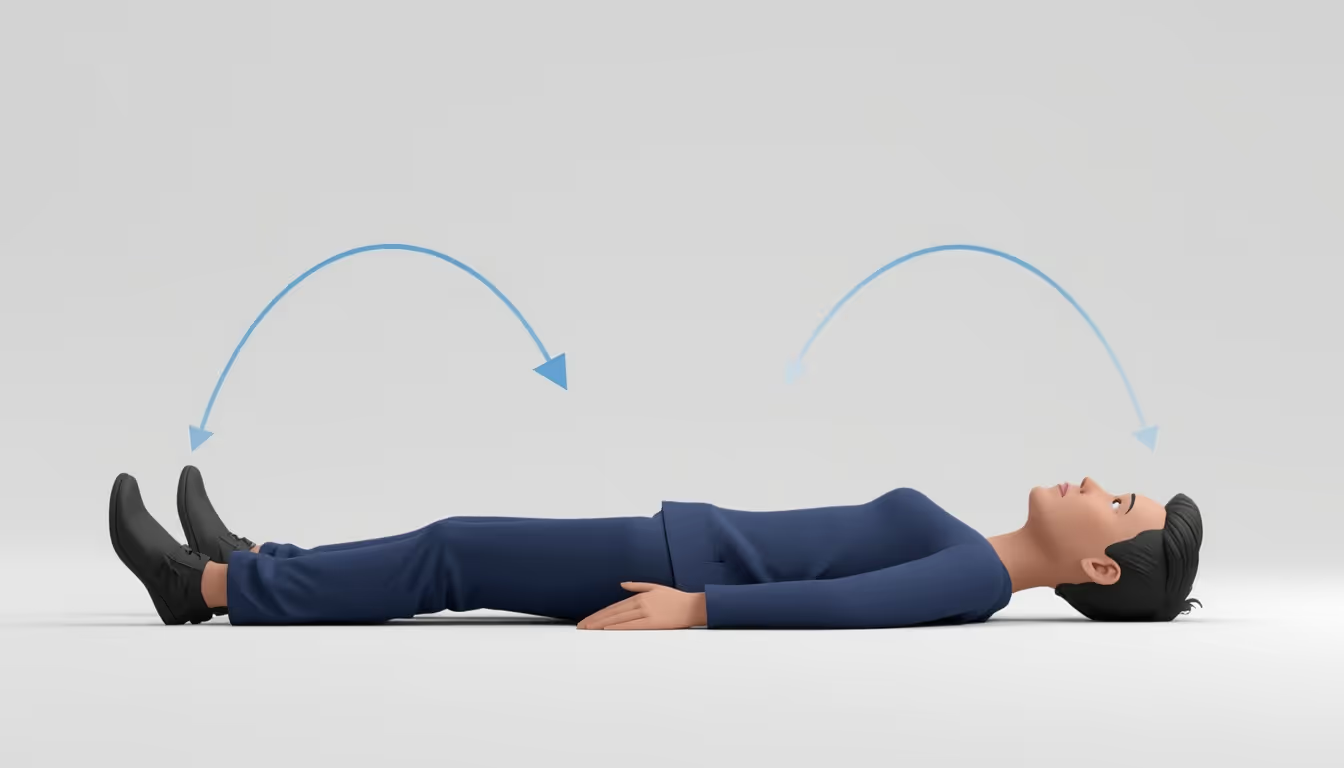
What Is the Epley Maneuver?
The Epley Maneuver is a series of carefully timed head and body position changes performed to treat Benign Paroxysmal Positional Vertigo (BPPV) — the most common cause of vertigo (a spinning sensation). BPPV occurs when tiny calcium crystals in the inner ear (called otoconia, or "ear rocks") become dislodged and move into the semicircular canals, disrupting your sense of balance.
The Epley Maneuver works by guiding these crystals out of the canal and back to where they belong, relieving dizziness in many patients after just one or two sessions.
What to Expect
Your provider will perform the maneuver in the office. During the repositioning movements, you may feel a brief episode of dizziness or spinning — this is expected and means the maneuver is working. Each position is held for approximately 30 seconds, or until any dizziness subsides. The full maneuver takes about 5–10 minutes.
Understanding "Right Side" vs. "Left Side"
BPPV almost always affects one ear at a time, and the direction of every step depends on which ear is affected — not which hand you write with or which side feels "dominant."
- If your right ear is affected: you start with your head turned toward the right, and the sequence moves you through turning left, rolling onto your left side, and sitting up on the left.
- If your left ear is affected: everything is mirrored — you start with your head turned toward the left, then turn right, roll onto your right side, and sit up on the right.
Your provider determines which ear is affected using a diagnostic test (the Dix-Hallpike test) before starting the maneuver. If you are doing this at home and are unsure which ear is affected, contact our office before attempting it — performing it in the wrong direction won't help and may prolong symptoms.
Step-by-Step Instructions — Right Ear Affected
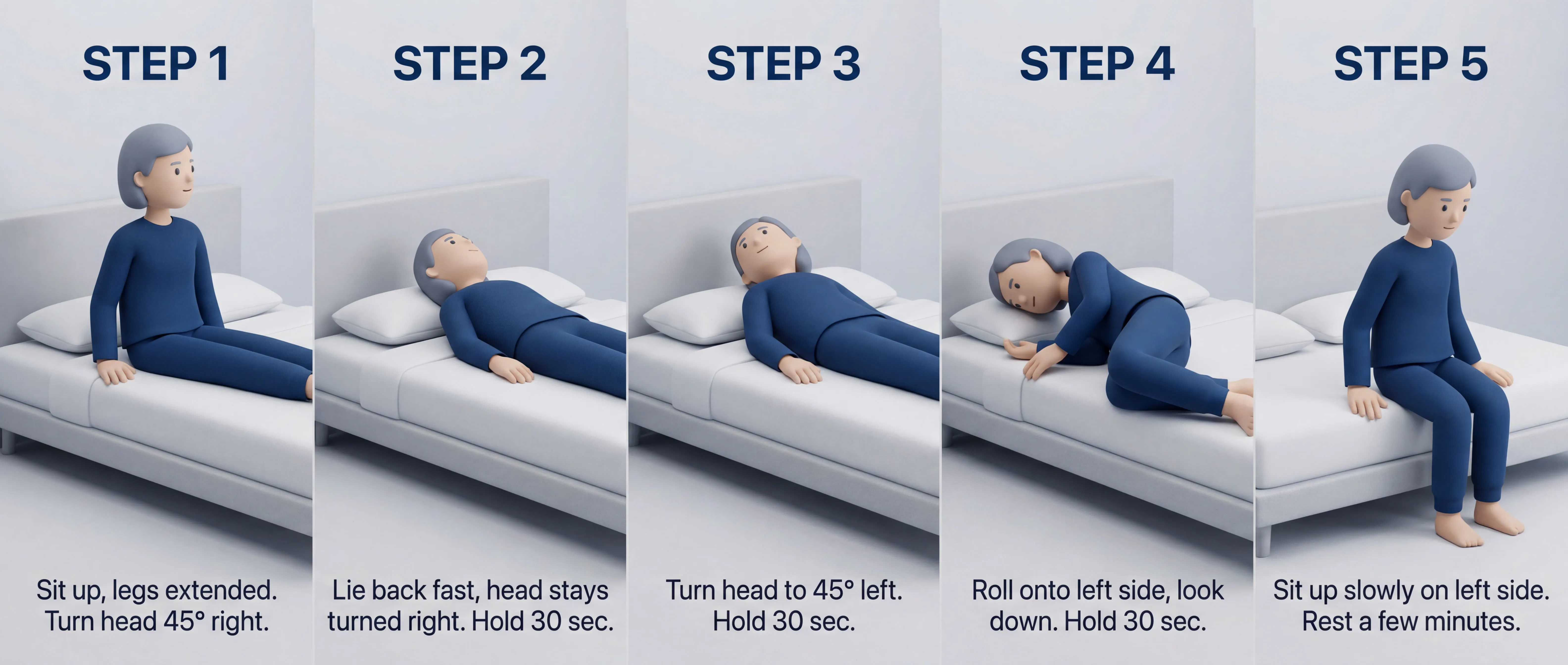
Hold each position for about 30 seconds, or until any dizziness stops.
- Start seated upright on a bed with your legs extended in front of you. Place a pillow behind you, positioned so it will rest under your shoulders (not your head) when you lie back. Turn your head 45 degrees to the right.
- Lie back quickly so your shoulders rest on the pillow and your head reclines slightly backward, keeping the 45-degree turn to the right. Hold for 30 seconds or until dizziness subsides.
- Turn your head 90 degrees to the left — without lifting it — so it is now turned 45 degrees to the left. Hold for 30 seconds.
- Roll onto your left side, turning your head and body together so you are looking down toward the floor. Hold for 30 seconds.
- Sit up slowly on the left side of the bed, keeping your chin slightly tucked. Remain seated for a few minutes before standing.
Step-by-Step Instructions — Left Ear Affected
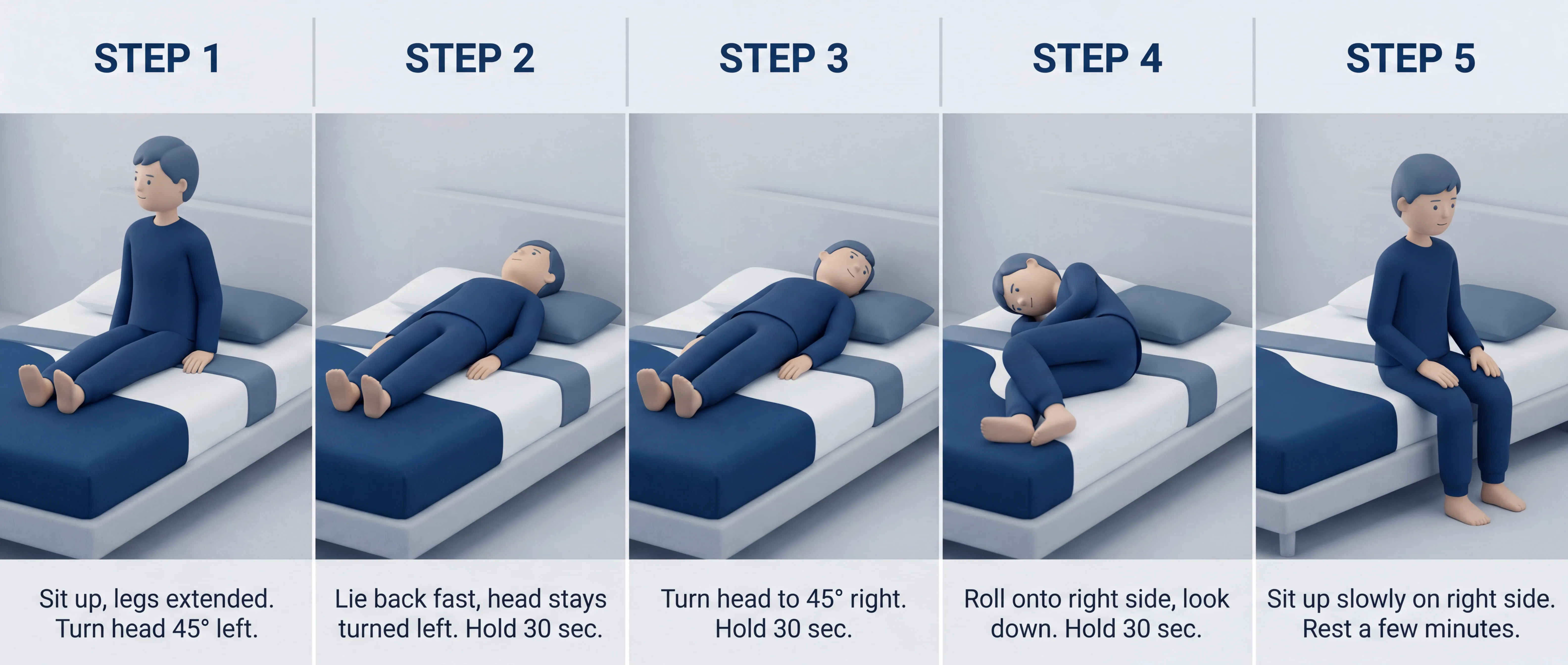
Hold each position for about 30 seconds, or until any dizziness stops.
- Start seated upright on a bed with your legs extended in front of you. Place a pillow behind you, positioned so it will rest under your shoulders (not your head) when you lie back. Turn your head 45 degrees to the left.
- Lie back quickly so your shoulders rest on the pillow and your head reclines slightly backward, keeping the 45-degree turn to the left. Hold for 30 seconds or until dizziness subsides.
- Turn your head 90 degrees to the right — without lifting it — so it is now turned 45 degrees to the right. Hold for 30 seconds.
- Roll onto your right side, turning your head and body together so you are looking down toward the floor. Hold for 30 seconds.
- Sit up slowly on the right side of the bed, keeping your chin slightly tucked. Remain seated for a few minutes before standing.
If your provider has recommended performing the maneuver at home, it may be repeated up to three times a day until you have been free of vertigo for 24 hours.
After the Maneuver
- You may feel slightly unsteady after the procedure — this is normal and typically resolves within a few minutes.
- Avoid lying flat on your back for the remainder of the day.
- Sleep with your head elevated at about 45 degrees for the first night (use two pillows).
- Avoid bending over, tipping your head back, or rolling onto the affected side for 24–48 hours.
- Your provider will advise you on whether a follow-up visit or at-home exercises are needed.
Success Rate
The Epley Maneuver is highly effective — studies show it relieves BPPV symptoms in approximately 80% of patients after a single treatment session. Some patients may need the maneuver repeated once or twice. If dizziness returns or does not improve, contact our office.
When to Call Our Office
Contact Sleep and Sinus Centers if your dizziness worsens, if you experience new hearing loss, ringing in the ears, difficulty walking, or if symptoms do not improve within 1–2 weeks of treatment.
Don’t let allergies slow you down. Schedule a comprehensive ENT and allergy evaluation at Sleep and Sinus Centers of Georgia. We’re here to find your triggers and guide you toward lasting relief.